Goal
Produce fresh water from ambient humid air using a compact, cyclic absorption-regeneration process.
Problem
Scarcity of fresh water in arid and remote regions; need for renewable, low-energy water sources.
Concept Summary
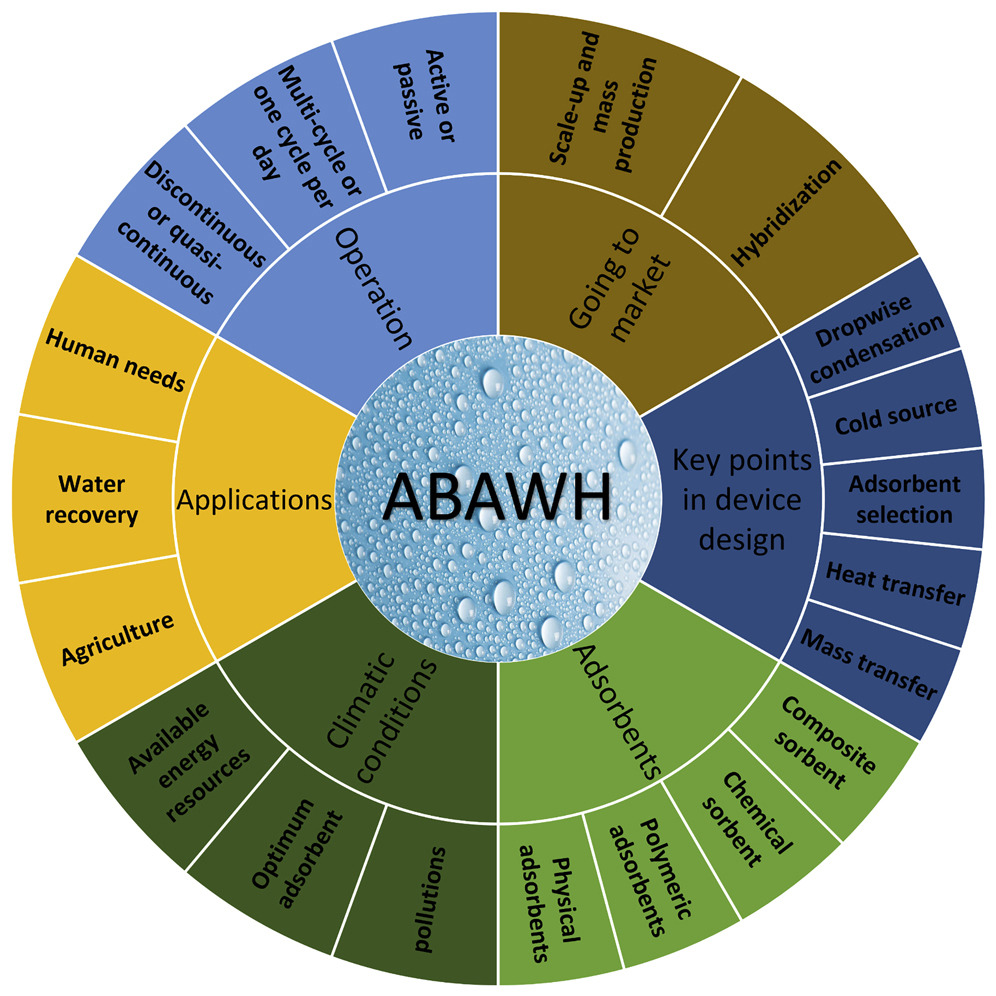
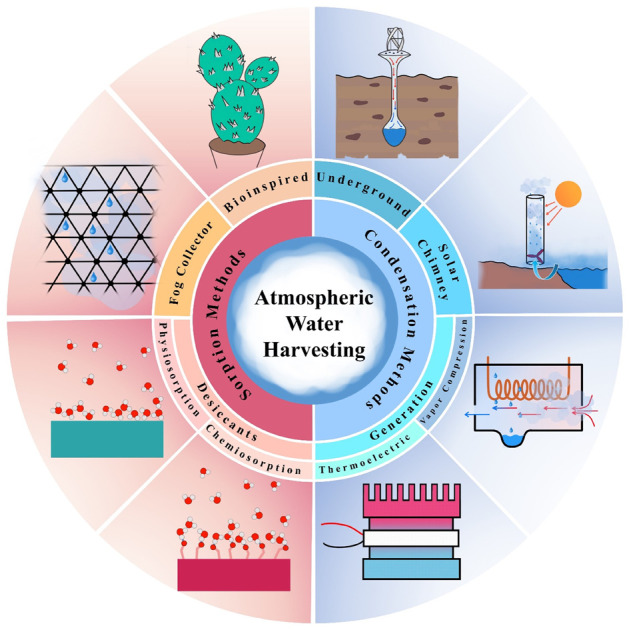
A compact system uses two identical packed-tower columns whose beds are made of vertical cloth layers impregnated with calcium-chloride solution. Moist air is forced through the beds, where the hygroscopic desiccant adsorbs water. After a set cycle time the beds are regenerated by heating (solar or forced-air), releasing the water vapor for condensation. System efficiency depends on cycle time, desiccant concentration, air velocity and temperature.
Detailed Description
The system consists of two parallel columns, each packed with multi-layer cloth material saturated with CaCl_2 solutions of varying concentration. During the absorption phase, ambient air is passed by forced convection; the cloth-desiccant adsorbs moisture. In the regeneration phase, the columns are heated (often using solar radiation) to desorb water, which is then condensed and collected. Numerical modelling based on experimental data predicts performance under different operating conditions. Peak efficiencies are observed at specific cycle times, final desiccant concentration, regeneration temperature, and air stream velocity. The authors report that efficiency rises with higher initial desiccant concentration and falls with higher regeneration air velocity and absorption temperature.
Principles
- Hygroscopic adsorption
- Desiccant regeneration by heating
- Forced convection mass transfer
- Heat-mass balance efficiency definition
Scientific Domains
Materials
- Cloth (fabric)
- Calcium chloride (CaCl_2) solution
- Water
Mechanisms of Action
- Moisture adsorption onto calcium-chloride impregnated cloth
- Thermal desorption (regeneration) of water from the desiccant
- Condensation of water vapor into liquid
Energy Sources
Applications
- Off-grid fresh water generation
- Arid-region water supply
- Emergency disaster relief water production
Claimed Performance
Peak system efficiency defined by cycle parameters; experimental data show dependence on desiccant concentration, air velocity and temperature. A related solar-pyramid system achieved ~=2.5 L day^-^1 m^-^2 and 9 kg of solution absorbed per bed.
Experimental Evidence
Laboratory-scale packed-tower tests with cloth-CaCl_2 beds; numerical model validated against measured water uptake and regeneration performance. Separate field tests of a solar glass-pyramid collector demonstrated measurable water production.
Replication Status
Prototype tested experimentally; no independent third-party replication reported.
Limitations
- Performance strongly dependent on ambient humidity and temperature
- Requires solar or other heat source for regeneration
- Potential corrosion of metal components by chloride ions
- Desiccant degradation or swelling over many cycles