Goal
Enable mask-less, 3-D atomic-scale printing and additive manufacturing at wafer scale with sub-nanometer feature sizes.
Problem
Current nanofabrication techniques (e.g., electron-beam lithography) are limited by mask requirements, resolution >0.2 nm, and low throughput.
Concept Summary
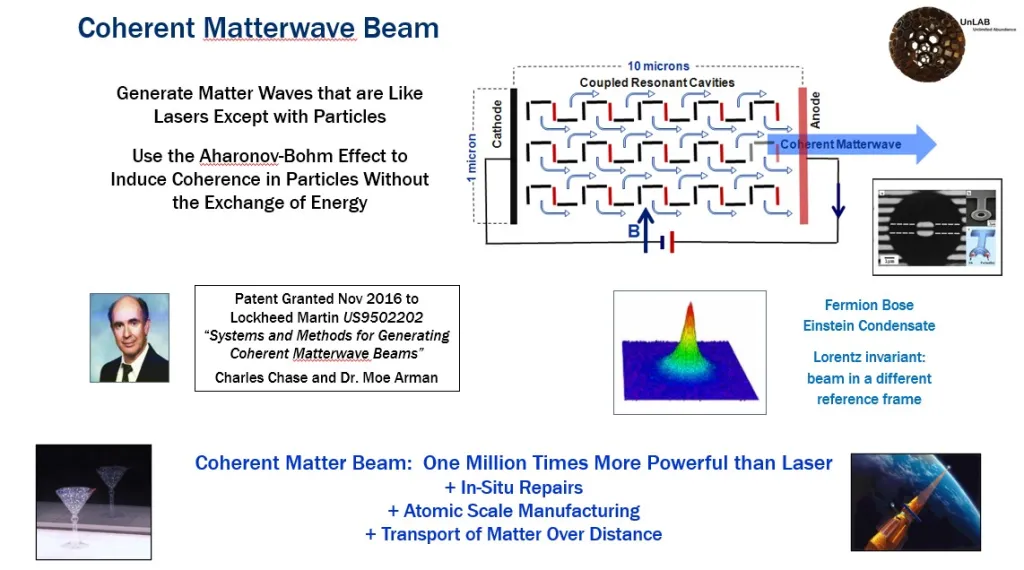
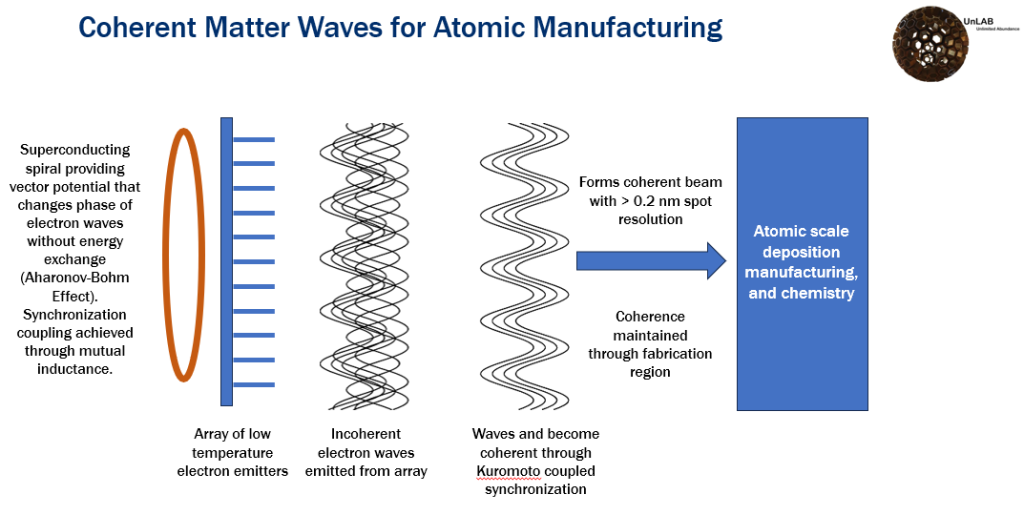
A coherent matter-wave beam is generated by synchronizing multiple low-energy charged-particle emitters using the Aharonov-Bohm effect (phase change without energy exchange) and Kuramoto-type coupled-oscillator synchronization via mutual inductance of superconducting loops. The resulting beam maintains phase coherence across the manufacturing zone, allowing atomic-scale patterning, deposition, and assembly without masks.
Principles
- Aharonov-Bohm phase control
- Kuramoto synchronization of coupled oscillators
- Superconducting loop mutual inductance
- Bose-Einstein condensate-like coherence
- Artificial gauge field manipulation
Scientific Domains
Materials
- Superconducting loop material (e.g., Niobium)
- Low-temperature electron emitter arrays
- Vacuum chamber components
- Magnetic field coils
Mechanisms of Action
- Phase shift induced by vector potential of superconducting loops
- Coupling of emitters via mutual inductance
- Synchronization of particle streams to a single coherent matter wave
- Low-temperature electron emission
Energy Sources
Applications
- Atomic-scale additive manufacturing
- Nanodevice fabrication
- Advanced semiconductor manufacturing
- Molecular assembly
Claimed Performance
Resolution down to 0.2 nm, manufacturing rate greater than electron-beam lithography.
Experimental Evidence
The patent describes a system architecture and a prototype is being sought; no quantitative experimental data are provided.
Replication Status
No independent replication reported; prototype development only.
Limitations
- Requires cryogenic temperatures for superconducting loops
- Maintaining phase coherence over large wafer areas
- Scalability of synchronized emitter arrays
- Lack of demonstrated experimental results
Red Flags
- No quantitative experimental data provided
- Prototype still in concept stage; funding sought
- Reliance on theoretical synchronization mechanisms that have limited experimental validation