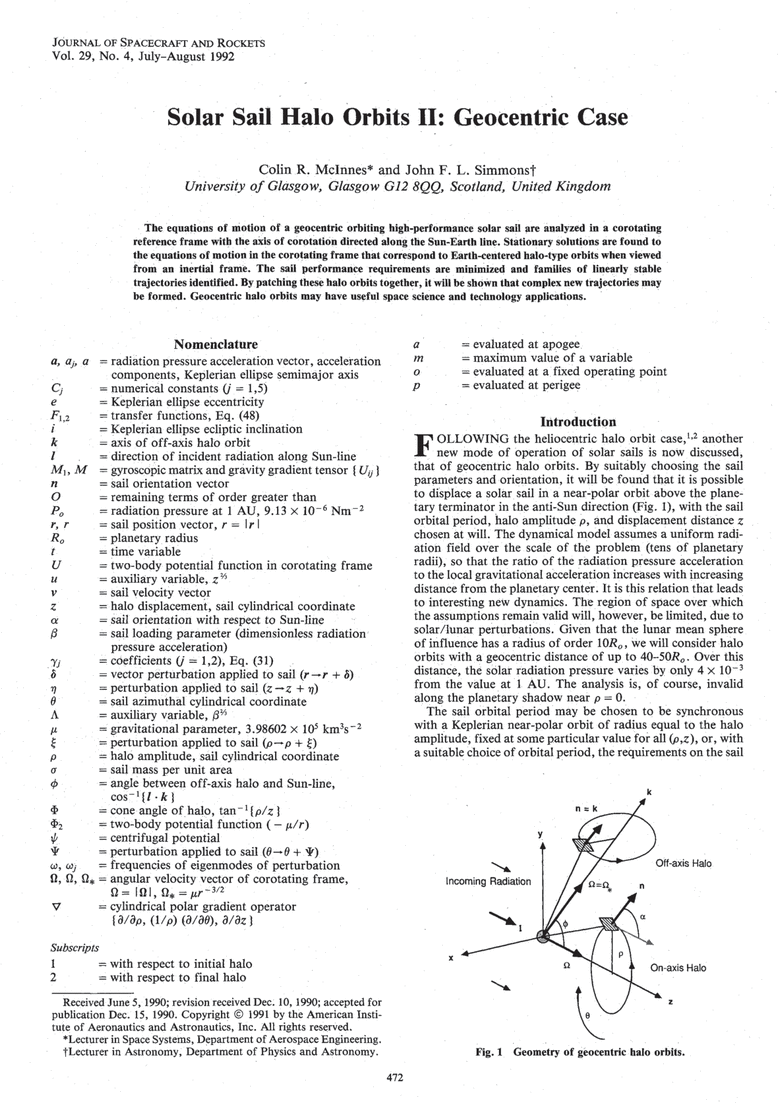
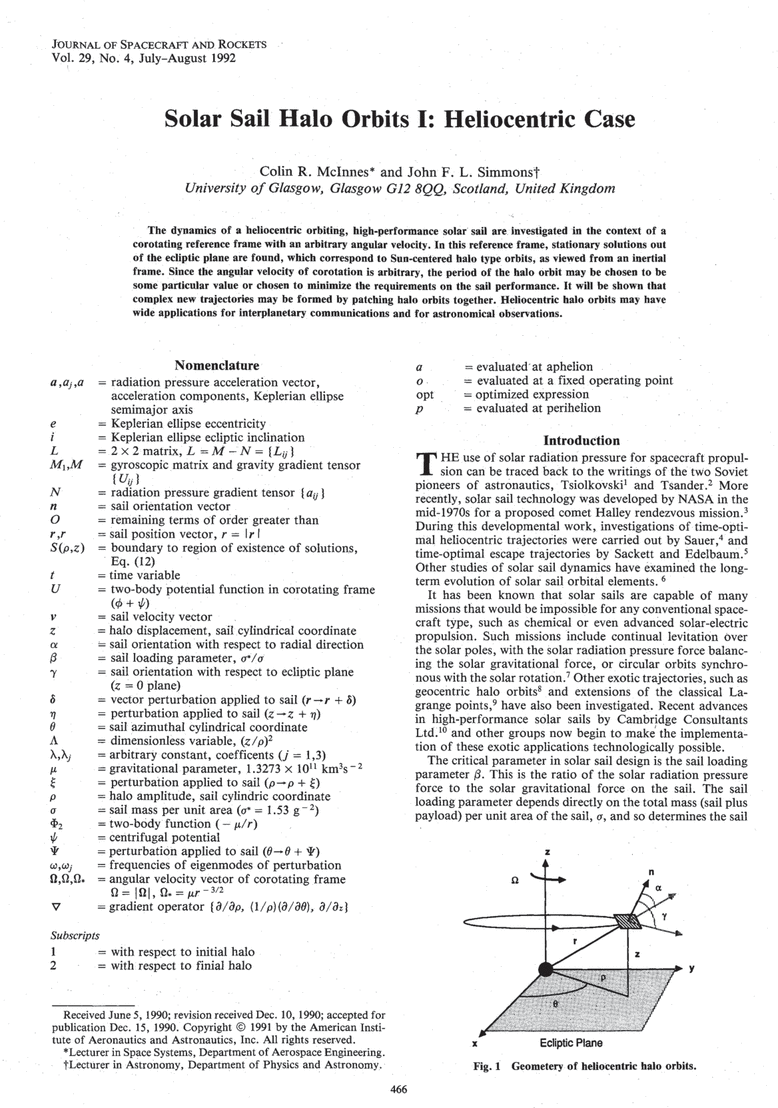
Goal
Maintain a spacecraft at a fixed position relative to a celestial body using solar-sail light pressure to counteract gravity, enabling non-Keplerian (hover) orbits.
Problem
Limited number of stable orbital slots and inability to hold a spacecraft at fixed high-latitude or polar positions for continuous observation or communications.
Concept Summary
A statite is a spacecraft equipped with a large, highly reflective solar sail that generates continuous photon-pressure thrust opposite the local gravitational pull. By balancing these forces, the craft can hover at a point that is not a natural orbit, creating a non-Keplerian stationary position.
Principles
- radiation pressure
- photon momentum transfer
- non-Keplerian orbital dynamics
Scientific Domains
Materials
- thin reflective membrane
- aluminum-coated Mylar
- polyimide film
Mechanisms of Action
- solar sail thrust opposing gravity
- continuous photon pressure to maintain equilibrium
Energy Sources
Applications
- continuous high-latitude communications observation
- polar communications relay
- space solar power station-keeping
Claimed Performance
Can hover at fixed points above Earth's poles or at displaced geostationary positions (10-25 km above the equatorial plane) using a high-performance solar sail.
Experimental Evidence
Analytical proofs and numerical simulations of displaced non-Keplerian orbits; no physical prototype or in-orbit demonstration to date.
Replication Status
No statites have been deployed; the concept remains at the theoretical/simulation stage.
Limitations
- Requires ultra-light, highly reflective sail material
- Material degradation in space environment
- Limited thrust magnitude
- No existing flight-qualified hardware