Goal
To enhance the growth of aquatic organisms and to create solid mineral structures in seawater for marine construction, coral reef restoration, coastal protection, and related applications.
Problem
Degradation of coral reefs, coastal erosion, and the need for durable, environmentally friendly marine construction materials.
Concept Summary
Electrodeposition of calcium carbonate and magnesium hydroxide onto cathodic structures immersed in seawater, using a direct electric current to raise local pH and precipitate minerals, forming hard coatings and three-dimensional structures while providing a favorable environment for coral and other calcareous organisms.
Detailed Description
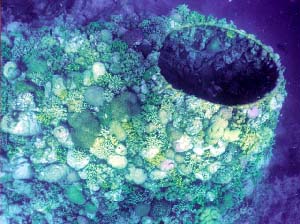
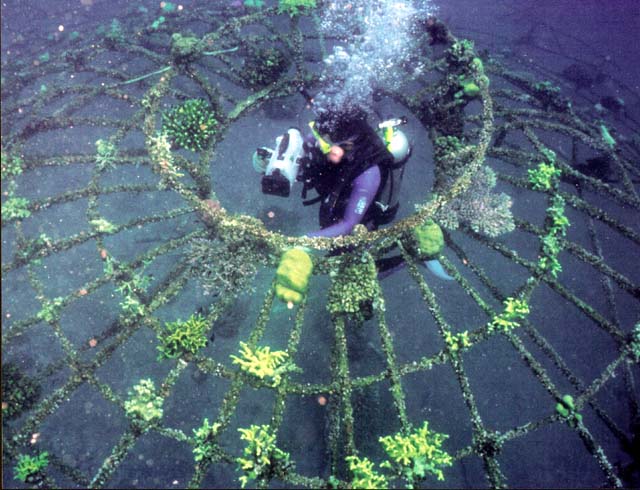
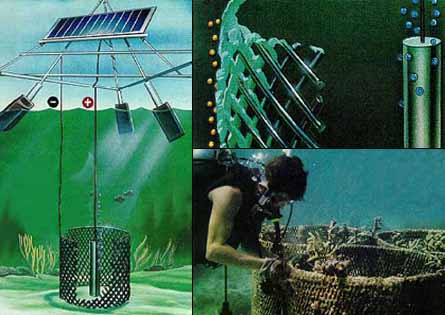
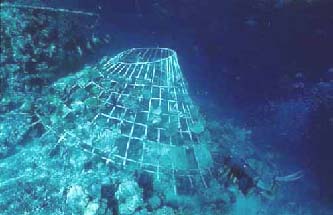
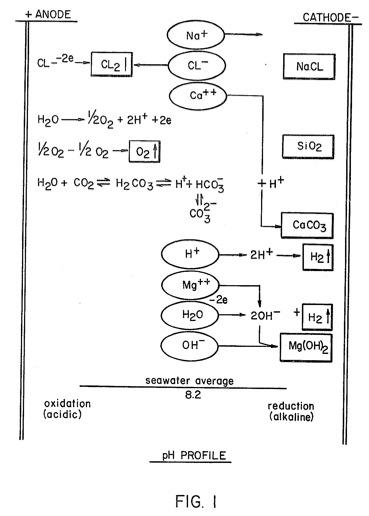
The BioRock process installs a cathode (often a conductive metal framework) and an anode in seawater. A steady, pulsed, or intermittent DC current is applied, causing electrolysis that makes the water near the cathode highly alkaline. This alkalinity precipitates calcium carbonate and magnesium hydroxide onto the cathode surface, building up a solid mineral coating or accreting structure. The same conditions promote rapid growth and higher survival of corals and other marine organisms attached to the structure. Variants of the method are used to coat wood, repair reinforced concrete, and extract magnesium hydroxide. Patents (US5543034, US4461684, US4440605, US4246075, DE102004039593) describe the method and its applications.
Principles
- Electrolysis
- Cathodic mineral precipitation
- pH elevation near cathode
- Electrodeposition
- Direct current (DC) application
Scientific Domains
Materials
- Seawater (electrolyte)
- Calcium carbonate
- Magnesium hydroxide
- Conductive metal cathode (e.g., steel, titanium)
- Anode material (e.g., titanium, platinum)
- Wood or other fibrous substrate (optional for coating)
Mechanisms of Action
- Direct electric current splits water, producing hydroxide ions at the cathode
- Local increase in alkalinity causes calcium and magnesium ions in seawater to precipitate as CaCO_3 and Mg(OH)_2
- Solid mineral layer builds up on the cathode, forming a hard coating or structure
- Elevated pH and mineral surface provide favorable conditions for calcareous organism growth
Energy Sources
Applications
- Coral reef restoration
- Coastal defense and erosion control
- Marine construction (breakwaters, piers)
- Mariculture infrastructure (oyster farms)
- Wood preservation
- Repair of reinforced concrete structures
Claimed Performance
Coral survival on Biorock structures reached 50-80 % under heat-stroke conditions where natural reefs survived only 1-5 %; accreted structures achieve compression strengths of 1000-8000 psi; large-area accretion demonstrated on surfaces >100 sq ft.
Experimental Evidence
Field demonstrations at multiple worldwide sites (e.g., Maldives 1998) showing increased coral survival; patents documenting laboratory and field tests; reported compression strengths of mineral accreted structures.
Replication Status
Demonstrated in numerous field projects and documented in several US and European patents; commercial entities (Biorock Inc.) have deployed the technology for reef restoration and marine construction.
Limitations
- Requires continuous electricity supply
- Effective only on conductive substrates
- Performance depends on seawater composition and temperature
- Scaling to very large structures may be energy-intensive