Goal
Create a high-strength, lightweight, renewable structural material that can replace steel and other heavy alloys in automotive, construction, and armor applications.
Problem
Current high-performance structural materials are heavy, expensive, or have large environmental footprints; a need for a low-cost, lightweight, strong, and sustainable alternative.
Concept Summary
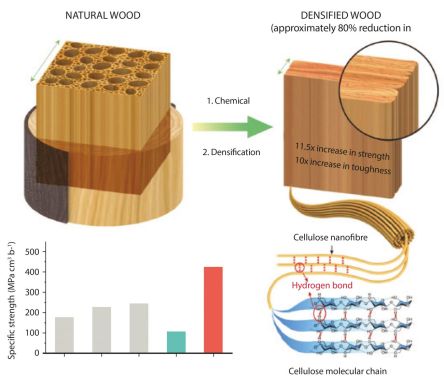
Bulk natural wood is chemically treated with an aqueous mixture of sodium hydroxide and sodium sulfite to partially remove lignin and hemicellulose. The treated wood is then hot-pressed, causing the cell walls to collapse and the cellulose nanofibers to align. The resulting densified wood exhibits a ten-fold increase in strength and toughness, excellent ballistic resistance, and natural fire, moisture, and termite resistance.
Detailed Description
The process consists of two main steps: (1) a boiling treatment in NaOH/Na_2SO_3 that delignifies the wood, preserving the cellulose nanofiber network; (2) hot-pressing at elevated temperature and pressure, which fully collapses the wood cell lumen, aligns the nanofibers, and creates extensive hydrogen bonding between them. The final material, called SuperWood or Mettlewood, retains a low density (~=50 % less than steel) while achieving a strength-to-weight ratio higher than most metals. Prototypes such as floor panels, roof panels, and armor plates have been demonstrated, and the material can be further machined or combined with adhesives for complex structures.
Principles
- Chemical delignification
- Hot-press densification
- Cellulose nanofiber alignment
- Hydrogen-bond network formation
Scientific Domains
Materials
- Wood (cellulose-based)
- Sodium hydroxide (NaOH)
- Sodium sulfite (Na_2SO_3)
- Adhesive (glue) for laminated structures
Mechanisms of Action
- Removal of weak lignin/hemicellulose polymers
- Alignment of cellulose nanofibers increases stiffness
- Hydrogen bonds between nanofibers enhance strength and toughness
- Densification collapses cell walls, raising load-bearing capacity
Applications
- Automotive structural components
- Building and construction panels
- Protective armor
- Lightweight vehicle bodies
Claimed Performance
10x strength and 12x toughness versus natural wood; up to 6x lighter than steel; can withstand 1 GPa pressure; ballistic resistance; fire, moisture, and termite resistance; reduces vehicle weight by up to 50 % and fuel consumption by 6-8 %.
Experimental Evidence
Nature (Feb 2022) reports a ten-fold increase in strength and toughness and ballistic tests where projectiles did not pierce the material. University of Maryland project aims for 1 GPa pressure resistance and has built floor-panel and roof-panel prototypes. Multiple peer-reviewed papers and patents document the process and performance.
Replication Status
Peer-reviewed publication, several granted patents, and ongoing university-scale prototype demonstrations.
Limitations
- Requires chemical treatment with NaOH/Na_2SO_3, raising waste-water handling concerns
- Potential dimensional stability issues in high humidity if not fully densified
- Scale-up of hot-pressing may need specialized equipment
- Long-term durability and recyclability not fully established