Goal
Provide a self-running power source (claimed ~400 W) using semiconductor electronics and high-voltage inductive coupling, allegedly achieving over-unity energy output.
Problem
Need for portable, independent power generation without external fuel; pursuit of excess-energy (over-unity) devices.
Concept Summary
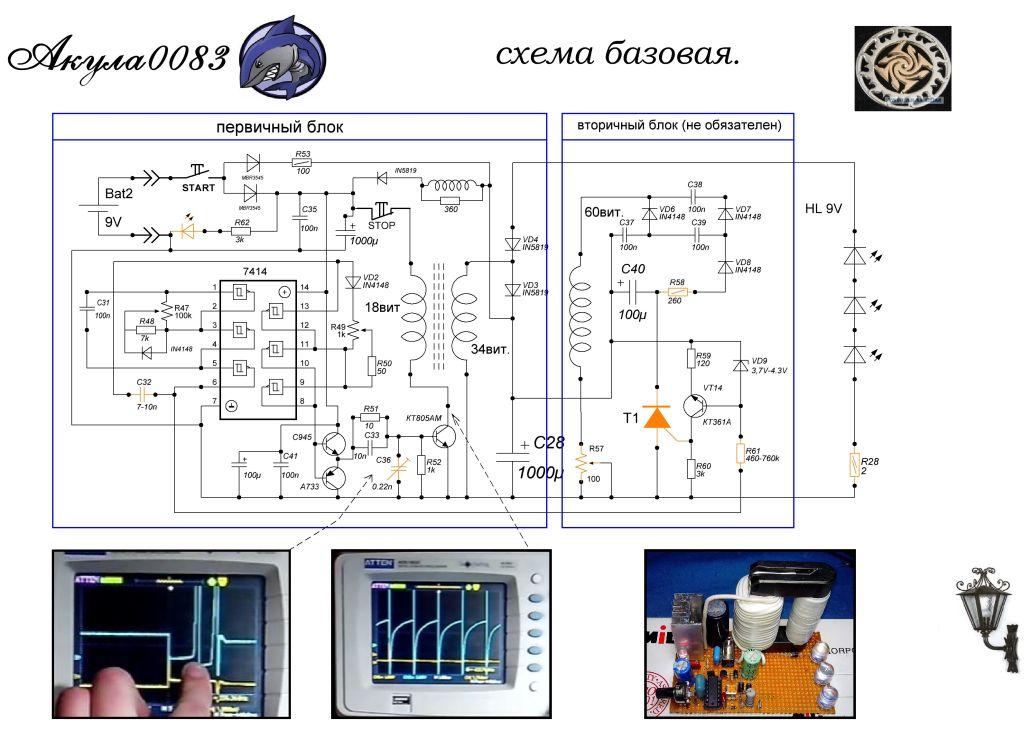
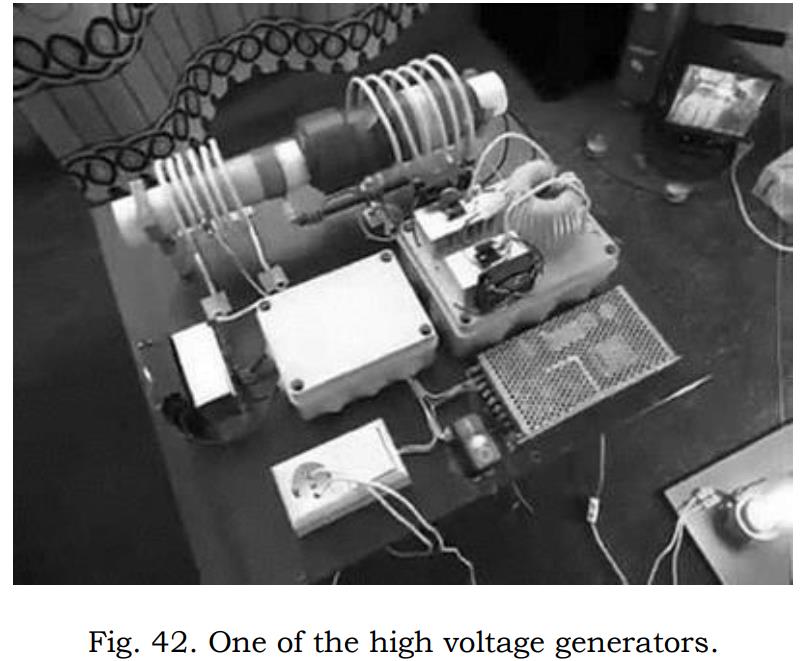
The Akula generator consists of a high-voltage coil-inductor with a toroidal capacitor that creates a strong electric field. A second "receiving" coil is placed nearby; the author claims that the electric field directly induces charge in the receiving coil (electrical induction, not conventional electromagnetic induction). The system is driven by pulsed MOSFET circuits, programmable unijunction transistors (PUT), and ferrite-core magnetic domains. Energy is harvested from the back-EMF (BEMF) of the coils, boosted by timed transistor pulses, and stored in capacitors that power LEDs and a load. The device is said to run autonomously and deliver up to 400 W.
Principles
- high-voltage electric field coupling
- pulsed power switching
- back-EMF energy recovery
- ferrite-core magnetic domain control
- resonant LC circuits
Scientific Domains
Materials
- Ferrite core
- Copper magnet wire
- Toroidal capacitor
- MOSFET transistors
- PNP transistor KT361A
- Programmable unijunction transistor (PUT)
- Diodes (including dual/triple shotky)
- Capacitors (C28, C40, etc.)
Mechanisms of Action
- High-voltage coil creates a strong electric field that induces charge in a nearby coil.
- MOSFET pulsing creates rapid flux changes in the core.
- BEMF from the collapsing magnetic field adds to transistor current, charging high-voltage capacitors.
- Ferrite core magnetic domains are reset at low frequency to prepare for the next pulse.
Energy Sources
Applications
- Portable power for remote locations
- Low-power lighting
- Experimental energy research
Claimed Performance
Self-running generator delivering ~400 W; over-unity energy claim (excess energy beyond input).
Experimental Evidence
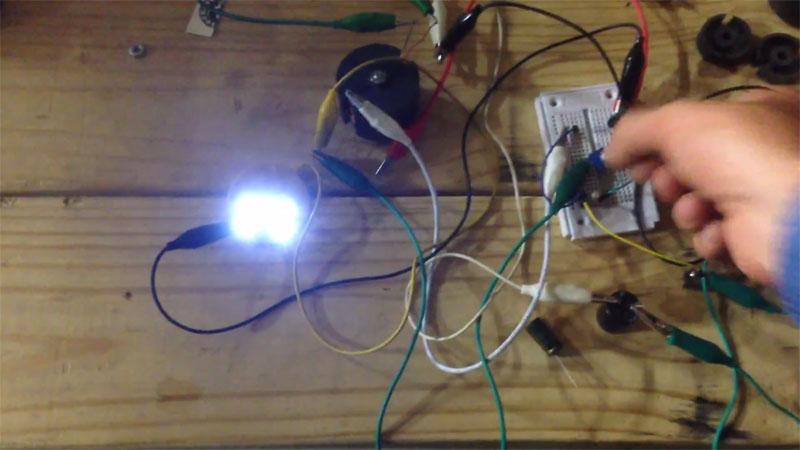
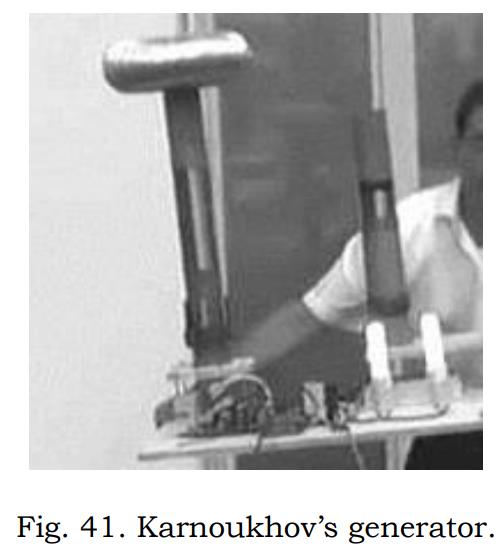
Forum posts describing a 400 W output, YouTube videos showing a working prototype, and a claimed replication by Avalon and Sergei Stalker. No peer-reviewed data provided.
Replication Status
Some independent hobbyists (Avalon, Sergei Stalker) claim to have replicated a small version, but no independent verification is documented.
Limitations
- No peer-reviewed validation of over-unity claim
- Circuit sensitivity to timing and component tolerances
- Potential component failure (e.g., PUT destruction on turn-on)
- Scalability and efficiency not demonstrated
Red Flags
- Claims of over-unity without quantitative, independent data
- Contradictory circuit analysis suggesting no net energy gain
- Heavy reliance on anecdotal videos and forum posts