Goal
Develop 2D siloxene-based materials for high-performance electrochemical energy storage, selective chemical sensing, and photocatalytic water treatment.
Problem
Need for electrode materials with high capacitance and stability, selective sensors for biomolecules, and efficient, low-cost photocatalysts for pollutant degradation.
Concept Summary
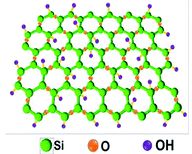
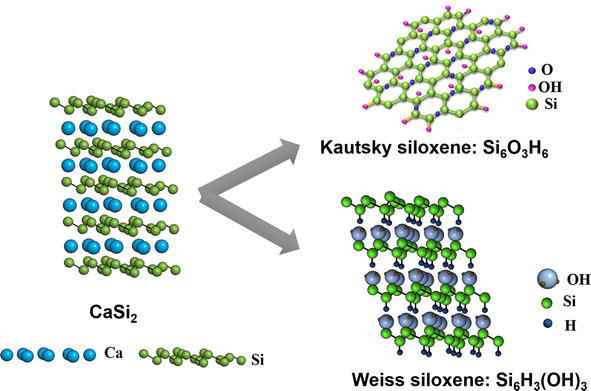
Siloxene is a two-dimensional silicon suboxide (Si6O3H6) with oxygen, hydrogen and hydroxyl functional groups. Its layered structure provides high surface area, tunable interlayer spacing and active sites that enable pseudocapacitive charge storage, ion intercalation for batteries, chemiluminescent indication, and photocatalytic activity. Various studies report its use as a supercapacitor electrode, lithium-/sodium-/potassium-ion battery anode, dopamine sensor, chemiluminescent titration indicator, and photocatalyst for dye degradation.
Principles
- Layered silicon suboxide (siloxene) structure
- Pseudocapacitance via intercalation/deintercalation
- Surface adsorption and catalytic reactions
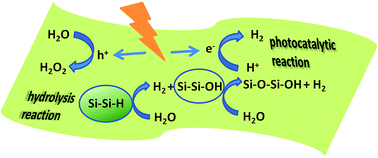
- Photogenerated charge carrier separation for photocatalysis
- Chemiluminescent emission from siloxene-like layers
Scientific Domains
Materials
- Siloxene (Si6O3H6)
- Hydroxyl groups
- Oxygen atoms
- Hydrogen atoms
Mechanisms of Action
- Ion intercalation/deintercalation in siloxene sheets
- Surface adsorption of dye molecules
- Photogenerated electron-hole pair formation under light
- Chemiluminescent reaction with oxidizing agents
Energy Sources
Applications
- High-performance supercapacitors
- Lithium-/sodium-/potassium-ion battery anodes
- Electrochemical dopamine biosensors
- Chemiluminescent indicators for titration
- Photocatalytic water treatment
Claimed Performance
Specific capacitance 2.18 mF cm^-^2, energy density 9.82 mJ cm^-^2, power density 272.5 mW cm^-^2, 98 % capacitance retention after 10 000 cycles; reversible capacities 2300 mAh g^-^1 (Li), 311 mAh g^-^1 (Na), 203 mAh g^-^1 (K); purified siloxene nanosheets give average capacity 810 mAh g^-^1 at 1000 mA g^-^1 over 200 cycles with 76 % retention.
Experimental Evidence
Cyclic voltammetry, galvanostatic charge-discharge, and long-term cycling tests on symmetric supercapacitor devices; battery tests showing high reversible capacities for Li/Na/K; ultrasonication-controlled morphology studies reporting 810 mAh g^-^1 capacity; photocatalytic experiments degrading methylene blue with adsorption isotherms fitting Langmuir model.
Replication Status
Multiple independent research groups have reproduced the electrochemical and photocatalytic performance; no commercial scale-up reported.
Limitations
- Synthesis reproducibility and purity control
- Long-term structural stability under repeated cycling
- Scale-up of 2D sheet production