Goal
Enable the body to regenerate lost or damaged bone by providing a strong, highly porous scaffold that supports bone-cell growth and vascularisation.
Problem
Bone loss and defects caused by periodontitis, mandibular cancer surgery, trauma, osteoporosis and other conditions where natural bone healing is insufficient.
Concept Summary
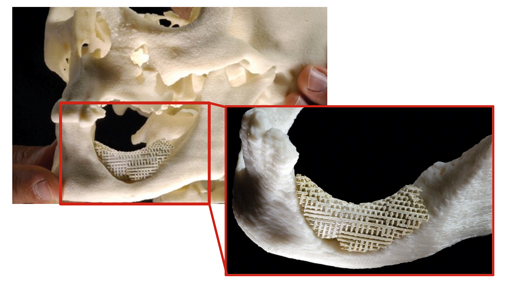
A porous, foam-rubber-shaped scaffold made from medical-grade titanium-dioxide nano-particles is implanted into a bone defect. The scaffold's 90 % open porosity mimics trabecular bone, allowing bone cells, blood vessels and (optionally) patient-derived stem cells to populate it, leading to new bone formation that is as strong as native bone.
Detailed Description
The invention consists of a mixture of water and medical-grade TiO_2 nano-particles poured into a pre-shaped ultrapure foam-rubber form that replicates trabecular bone geometry. After solidification the foam is removed by heating, leaving a solid TiO_2 scaffold with a mirror-image porous network. The scaffold can be cut to size and, if needed, seeded with autologous bone-marrow or progenitor cells before implantation. In animal studies (rabbits, pigs, dogs) the scaffold supported bone regeneration and vascular ingrowth. Clinical trials on human patients with periodontitis and mandibular defects are planned.
Principles
- Tissue engineering
- Osteoconduction
- Porous scaffold architecture
- Use of nano-titanium dioxide for biocompatibility
- Stem-cell seeding to accelerate regeneration
Scientific Domains
Materials
- titanium dioxide (nano-particles)
- water
- foam rubber (polymer matrix)
Mechanisms of Action
- Provides structural support for bone defect
- Acts as an osteoconductive matrix
- Facilitates cell attachment, proliferation and differentiation
- Allows vascular ingrowth for nutrient delivery
- Can be seeded with autologous stem cells to speed tissue formation
Applications
- Dental bone regeneration
- Mandibular reconstruction after cancer or trauma
- Orthopedic bone repair
Claimed Performance
Scaffold strength comparable to native bone; 90 % open porosity; supports bone and blood-vessel growth; can be manufactured like cinder blocks and cut to shape.
Experimental Evidence
Successful implantation and bone regeneration demonstrated in rabbit, pig and dog models; clinical studies on human patients planned for 2014 onward.
Replication Status
Animal testing completed; human clinical trials not yet performed.
Limitations
- Requires surgical implantation
- Large defects may need additional stem-cell seeding
- Long-term human durability not yet proven