Goal
To harvest ambient electromagnetic energy and generate electrical power without the use of traditional chemical batteries, achieving higher voltage and current than the input source.
Problem
Dependence on costly, hazardous chemical batteries and limited energy density of conventional generators; need for a low-cost, portable power source.
Concept Summary
The invention combines a modified Ruhmkorff coil with a large-section secondary winding and a simple electro-chemical cell (copper, carbon powder, water, zinc) to capture ambient electromagnetic fields and amplify the induced current. By varying PWM parameters (amplitude, frequency, duty cycle) the device claims to produce over-unity power, delivering several hundred watts from a low-voltage battery or ambient EM energy.
Detailed Description
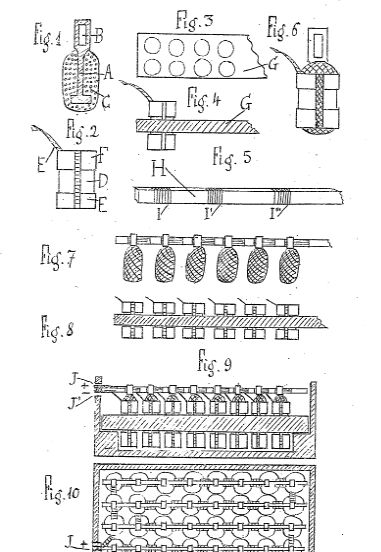
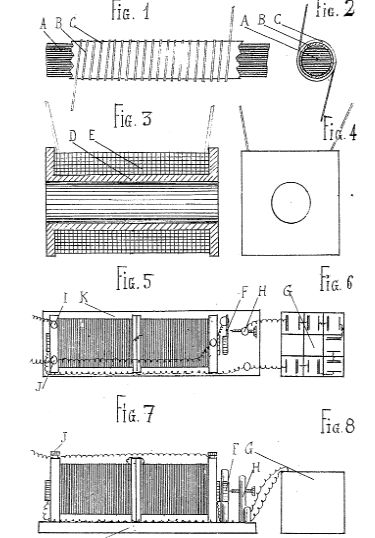
Two patents are described. FR667647A (1929) presents an induction machine where a primary coil (50 turns) drives a secondary coil (1000 turns) wound with thick wire; the secondary's cross-section is claimed to increase current capture, and PWM modulation is used to optimise the coefficient of performance. Experimental videos claim over-unity from a step-up transformer. FR633752A describes a battery-type generator replacing the classic copper-acid-zinc chain with copper-water-zinc, using carbon-powder bags soaked in water as the positive electrode. The device allegedly delivers high voltage (up to 660 V) and sufficient current to run a 10 HP motor for 30 h after a short re-soak, with low internal resistance and no hazardous chemicals.
Principles
- Electromagnetic induction
- Ambient energy harvesting
- Wire cross-section scaling
- Pulse-width modulation (PWM) control
- Electro-chemical reaction with carbon powder and water
Scientific Domains
Materials
- Copper wire
- Zinc
- Carbon powder
- Water
- Fiber insulating board
Mechanisms of Action
- Step-up transformer effect
- Ambient EM field capture
- Secondary coil current amplification via larger conductor area
- Chemical energy release from carbon-water-zinc cell
Energy Sources
Applications
- Lighting
- Heating
- Motive power for vehicles
- Industrial machinery
- Electrical generation in remote locations
Claimed Performance
Step-up transformer delivering 300 W from a 30 W input (10x multiplication); ambient energy density claimed at 2 kWh kg^-^1; 660 V 1.5 A output from a 0.03 m^3 battery weighing 15 kg; ability to run a 10 HP motor for 30 h after re-soak.
Experimental Evidence
YouTube videos (e.g., https://youtu.be/q3yijGqZnZA, https://youtu.be/pp7GZuUhECs) show bench-scale tests with resistive loads and PWM variation, claiming over-unity operation. No peer-reviewed data or independent replication is provided.
Replication Status
No independent replication reported; only the author's demonstration videos are cited.
Limitations
- Lack of peer-reviewed validation
- Claims rely on unverified over-unity
- Scalability and long-term stability not demonstrated
- Dependence on ambient EM field strength, which is variable
Red Flags
- Over-unity claims contradict conservation of energy
- Debunked by community discussion (reddit) and labeled as pseudoscience
- No independent experimental verification