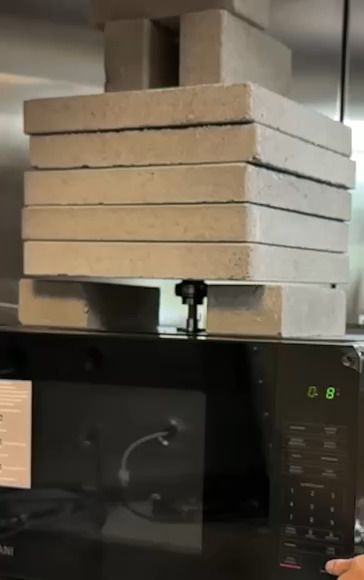
Goal
Provide reactionless propulsion capable of lifting large masses without expelling reaction mass.
Problem
The need for propellant-free thrust for spacecraft and vehicles, eliminating the mass penalty of conventional reaction-based propulsion.
Concept Summary
The Space Drive claims to generate lift by a free electron absorbing a photon while moving relative to an absolute-space inertial frame, transferring photon energy to electron kinetic energy without a conventional reaction partner. The effect is manifested as directional plasma confinement and supersonic plasma jets that produce measurable lift when driven by short bursts of microwave power.
Detailed Description
A high-vacuum chamber is filled with an argon-hydrogen plasma (~=5 % H_2). Microwave power (~=330 W) is applied for ~40 ms, creating a plasma jet that is confined by the proposed "space-drive" mechanism. The lift is observed as a supersonic propagation of plasma pressure that pushes a quartz weight plate upward, producing a measured lift of 46.9 kg (103.3 lb). The measured lift matches theoretical predictions based on the photon-electron interaction model. The device demonstrates a weight-to-power ratio of roughly 3 W/lb, far exceeding conventional rocket propulsion metrics.
Principles
- Photon absorption by moving free electron
- Conservation of momentum via spacetime propagation
- Microwave-induced plasma generation
- Directional plasma pressure and jet confinement
- Supersonic lift generation
Scientific Domains
Materials
- Argon
- Hydrogen
- Quartz
- Gasketed quartz plate
- Vacuum chamber
- Bladder (for pressure matching)
Mechanisms of Action
- Photon-electron kinetic energy transfer
- Microwave excitation of argon-hydrogen plasma
- Plasma jet formation and directional pressure
- Space-drive induced confinement of plasma
Energy Sources
Applications
- Spacecraft thrust without propellant
- High-lift atmospheric vehicles
- Rapid transit across long distances
Claimed Performance
Lift of 46.9 kg (103.3 lb) with 330 W microwave power applied for 40 ms (13.2 J); weight-to-power ratio ~=3 W/lb.
Experimental Evidence
The article reports a measured supersonic lift of 46.9 kg using 330 W of microwave power for 40 ms, matching calculated predictions.
Replication Status
Single prototype demonstration; no independent replication reported.
Limitations
- Requires high-vacuum chamber
- Lift demonstrated only for short 40 ms bursts
- Scalability to continuous operation not shown
- Dependence on specific gas mixture and microwave setup
Red Flags
- Extraordinary claim of reactionless thrust that conflicts with established physics
- No peer-reviewed publication or independent verification
- Reliance on proprietary terminology (e.g., "absolute space")