Goal
Generate a directed, gravity-like impulse beam that can exert a repulsive force on objects and be used for propulsion or other high-force applications.
Problem
Need for a laboratory-scale method to produce controllable gravity-like fields for propulsion, fundamental physics experiments, and potential high-energy impact tools.
Concept Summary
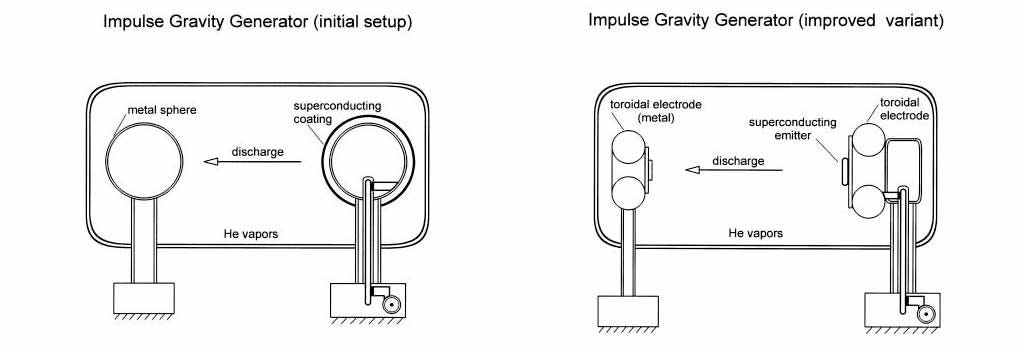
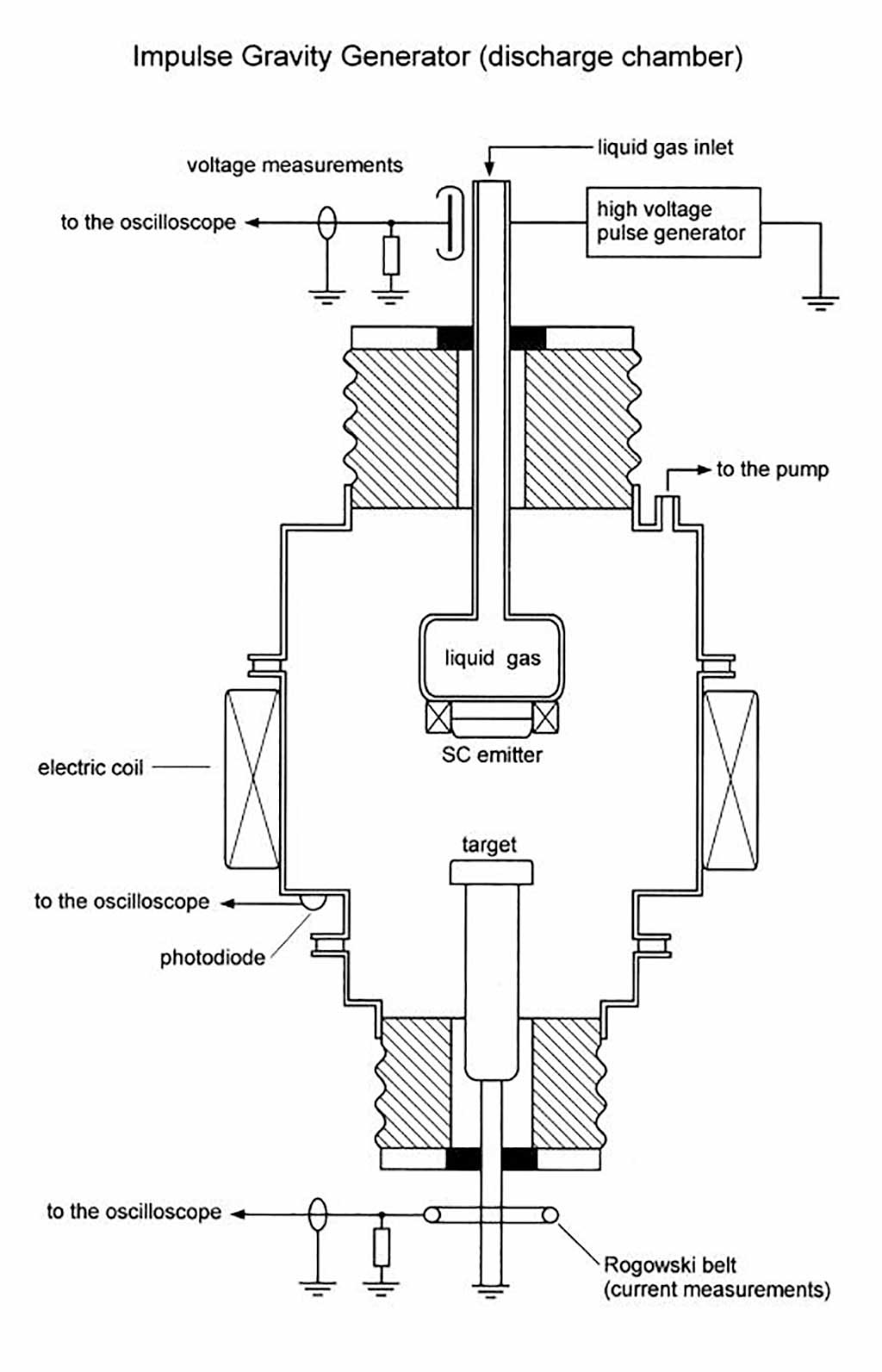
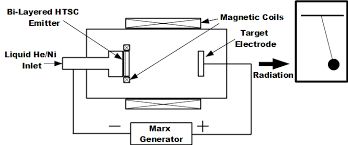
A high-voltage (up to several megavolts) discharge is sent through a high-Tc YBCO superconducting ceramic emitter placed in a strong magnetic field at cryogenic temperature (~40 K). The discharge creates a focused radiation-like beam that propagates with little attenuation and exerts a short, mass-proportional repulsive force on objects along its axis, resembling a gravitational impulse. The phenomenon is attributed to anomalous vacuum fluctuations and quantum-gravity effects beyond standard relativity.
Detailed Description
The apparatus consists of a Marx-type capacitor bank delivering peak currents >10^4 A and surface potentials >1 MV to a YBCO ceramic disc. The disc is cooled to ~40 K and subjected to a static magnetic field up to 1 T. During discharge a collimated beam is emitted, producing a measurable impulse on pendulums or small test masses up to hundreds of meters away. The impulse magnitude is reported to be proportional to the test mass (5-7 % measurement error) and independent of composition. Subsequent experiments attempted replication, observing mechanical recoil but failing to detect a consistent gravity-like signal.
Principles
- High-voltage pulsed discharge
- Superconductivity (high-Tc YBCO)
- Strong magnetic field confinement
- Quantum-gravity vacuum fluctuations
Scientific Domains
Materials
- YBa_2Cu_3O_7-y (YBCO) ceramic
Mechanisms of Action
- Peak current pulse through YBCO emitter
- Emission of a focused radiation/particle beam
- Interaction of the beam with matter producing a repulsive impulse
- Possible coupling of superconducting condensate to vacuum fluctuations
Energy Sources
Applications
- Spacecraft beamed propulsion
- Fundamental gravity research
- High-energy impact tools
Claimed Performance
Impulse proportional to test-mass (5-7 % error), capable of punching holes in concrete and deforming inch-thick steel plates; beam propagates over distances >150 m without measurable attenuation.
Experimental Evidence
Original experiments reported a measurable repulsive force on pendulums and mechanical recoil of the emitter; later independent attempts replicated the mechanical impulse but could not reproduce a consistent gravity-like signal, setting a lower detection limit of +/-0.48 % g.
Replication Status
Partial replication of mechanical impulse; no reliable, repeatable gravity-like signal observed in subsequent studies.
Limitations
- Lack of reproducible gravity-like signal
- Requirement of megavolt-level pulses and cryogenic temperatures
- Potential destruction of the emitter during high-energy discharges
Red Flags
- Claims of gravity-like forces without peer-reviewed verification
- Inconsistent replication results across independent groups
- Potential for over-statement of performance (e.g., punching steel plates)