Goal
Harvest electrical power from vacuum zero-point energy by modifying quantum vacuum modes with a Casimir cavity.
Problem
The lack of a practical method to extract usable energy from the quantum vacuum (zero-point energy) without violating known physical laws.
Concept Summary
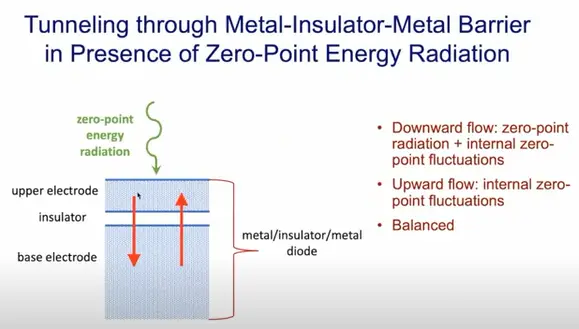
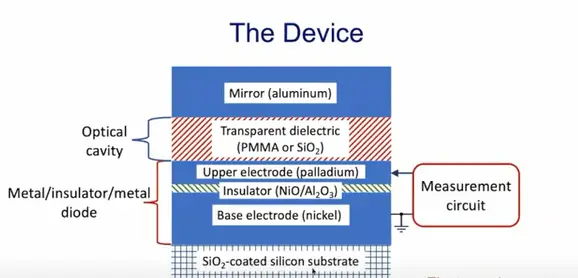
A sub-micron optical (Casimir) cavity is placed on one side of a metal-insulator-metal tunneling structure. The cavity suppresses low-frequency vacuum modes, breaking the symmetry of zero-point fluctuations on the two metal sides. This creates a net flow of hot electrons across the thin insulating barrier, producing a measurable electrical current and power without an external voltage source.
Principles
- Casimir effect
- Zero-point energy (vacuum fluctuations)
- Quantum vacuum mode suppression
- Electron tunneling
- Hot-carrier generation
- Plasmon excitation
- Uncertainty-principle-like energy-time relation
Scientific Domains
Materials
- Conductive metals (e.g., Al, Au)
- Transparent conductive oxides (e.g., ITO)
- Semiconductors
- Conductive polymers
- Dielectric insulator layers (nanometer-thick)
- Metallic reflectors
Mechanisms of Action
- Modification of vacuum electromagnetic mode density by a Casimir cavity
- Asymmetric excitation of electrons in a MIM tunneling junction
- Tunneling of hot electrons across a nanometer-scale insulating barrier
- Plasmon-mediated energy transfer
Energy Sources
Applications
- Low-power electrical generation
- Energy source for micro-electronics
- Potential propulsion systems (advanced concepts)
- Scientific instrumentation requiring self-powered sensors
Claimed Performance
Measured power density up to 70 W m^-^2; current increases as cavity thickness is reduced; theoretical photon flux of 1.7 GA m^-^2 from the background field.
Experimental Evidence
Multiple peer-reviewed papers (Phys. Rev. Res. 2021; Symmetry 2021) report measurable current from sub-micron optical cavities on MIM devices, with eight artifact-control tests ruling out conventional explanations. Video presentations show devices producing power in the lab.
Limitations
- Device size limited to sub-micron cavities
- Power density still modest compared to conventional sources
- No independent third-party replication reported
- Theoretical basis still controversial
Red Flags
- Claims of "free energy" and violation of the second law
- Reliance on unpublished or self-published data
- Lack of independent verification