Goal
Detect specific infections and transmit DNA information at extreme dilutions using electromagnetic signals and water nanostructures.
Problem
Inability to detect pathogen DNA at concentrations below Avogadro's number and lack of a mechanism for homeopathic dilutions to have biological effects.
Concept Summary
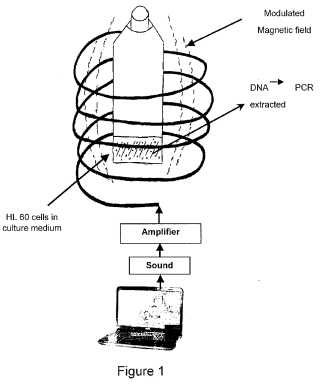
The invention proposes that highly diluted DNA induces nanostructures in water or other dipole solutions that emit characteristic electromagnetic signals (EMS). These EMS can be captured, amplified, stored, and retransmitted to reconstitute the original DNA sequence via PCR or to induce cytotoxic effects in living cells.
Principles
- Electromagnetic signal emission from aqueous nanostructures
- Information encoding of DNA sequences in water structures
- Signal capture, amplification, and retransmission
Scientific Domains
Materials
- Water
- Dipole solutions (e.g., saline)
- DNA (pathogenic bacterial or viral sequences)
- PCR reagents
Mechanisms of Action
- Diluted DNA induces nanostructures in water
- Nanostructures emit specific EMS frequencies
- EMS are detected and amplified, then used to drive PCR or affect cells
Energy Sources
Applications
- Early detection of viral and bacterial infections
- Diagnostic assays based on EMS signatures
- Therapeutic cytotoxic EMS for disease treatment
Claimed Performance
Detection of DNA information at dilutions beyond Avogadro's number; ability to induce cytotoxicity in cells through amplified EMS.
Experimental Evidence
2009 experiments showed that filtrates of Mycoplasma piri (filtered to remove DNA/RNA) still gave rise to colonies after inoculation; patents WO2012142568 and WO2016004430 describe methods and systems for EMS detection and cytotoxic signal generation.
Replication Status
No known replication attempts reported in the scientific literature.
Limitations
- Lack of peer-reviewed, reproducible data
- Mechanistic explanation remains speculative
- No independent replication of key experiments
Red Flags
- Claims rely on controversial 'water memory' and homeopathic principles
- No independent replication; peer-review concerns
- Potential classification as pseudoscience