Goal
Provide a low-tech, low-maintenance method to turn salt water into fresh water for irrigation and crop production in remote arid regions.
Problem
Scarcity of fresh water in isolated, dry locations and the high cost/complexity of conventional desalination technologies.
Concept Summary
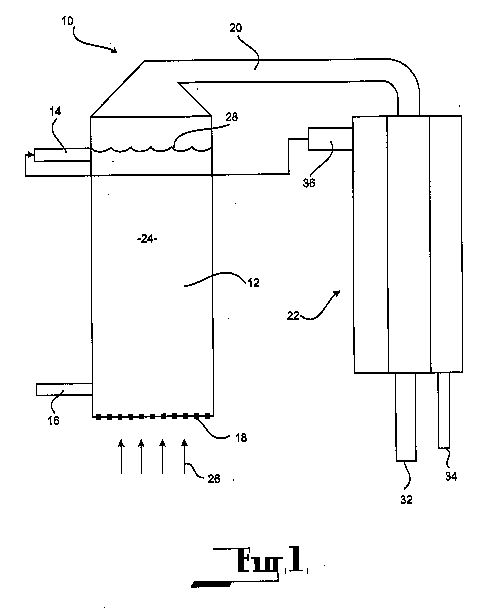
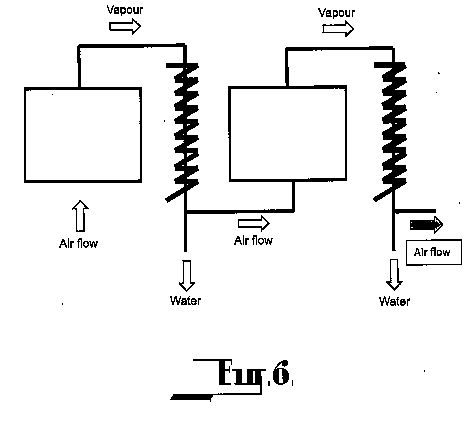
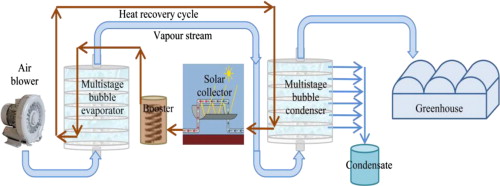
The Bubble-Greenhouse uses water-filled bubble columns in which a gas (air or an insoluble, non-toxic gas) is bubbled through saline water. The bubbles create a large interfacial area that extracts water vapor from the solution. The vapor is transferred to a heated air stream, then condensed in multistage condensers, producing fresh water for greenhouse irrigation. Latent heat is recovered via a heating/cooling circuit, and the system can be powered by low-grade sources such as solar-thermal, photovoltaic, wind, geothermal or waste heat.
Detailed Description
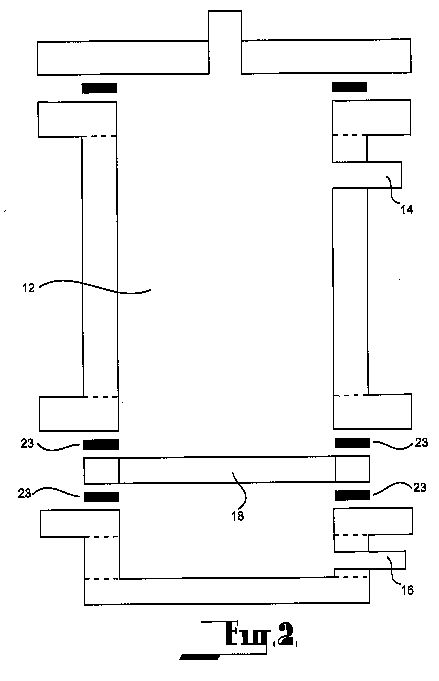
A method for desalinating water that passes gas bubbles through an aqueous saline solution, extracts water vapor into the bubbles, recovers the vapor, and condenses it to obtain fresh water. The process operates below the boiling point of the solution, uses bubble sizes of roughly 0.1-5 mm, and can handle salinities up to 4-6 x seawater. The system may incorporate a porous membrane to generate bubbles and can be powered by solar-thermal, photovoltaic, wind, geothermal, or waste-heat sources.
Principles
- Evaporation
- Condensation
- Bubble column mass transfer
- Latent heat recovery
- Low-temperature desalination
Scientific Domains
Materials
- Sodium chloride solution (seawater)
- Air (or other insoluble, non-toxic gas)
- Porous membrane (optional for bubble generation)
Mechanisms of Action
- Gas bubbles carry water vapor from the saline solution
- Large interfacial area enhances evaporation rate
- Condensation of vapor yields fresh water
- Heat exchange between evaporation and condensation stages recovers latent heat
Energy Sources
Applications
- Fresh water production for remote communities
- Agricultural irrigation in arid regions
- Small-scale water desalination for off-grid locations
Claimed Performance
A 150 m^2 Bubble-Greenhouse is estimated to produce ~8 m^3 of fresh water per day and up to 30 kg of crops; cost cited as US$10 per 1 000 kg of water produced.
Experimental Evidence
Prototype estimates published in the journal *Desalination* (June 2015) and a patent (AU2009217223); no independent replication reported.
Replication Status
Preliminary study complete; researchers are seeking industry partners to develop a working prototype; no commercial scaling or independent replication yet.
Limitations
- Relatively high energy cost per unit of water ($10 per 1 000 kg)
- Economic viability for staple crops uncertain
- Scale-up and long-term durability not yet demonstrated
Red Flags
- Cost may be uneconomical for staple crop production
- Higher energy requirements than reverse-osmosis for comparable output