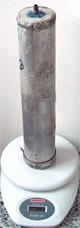
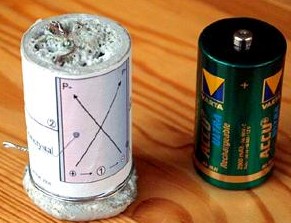
Goal
Provide a continuous electrical output without any observable external energy input.
Problem
Need for long-lasting, high-capacity power sources that do not require regular recharging or fuel.
Concept Summary
A sealed aluminium cylinder containing a crystallised mixture of sodium metasilicate (Na2SiO3) and calcite (CaCO3) that allegedly produces a continuous electrical current through galvanic or unknown internal processes.
Detailed Description
The device is an aluminium pipe (or cylinder) filled with a melt of sodium metasilicate and calcite that is allowed to crystallise. Internal electrodes are made of dissimilar metals (e.g., brass, copper, graphite, magnesium alloy). The crystal lattice is claimed to generate a continuous current, measured as >3000 mAh through a 910 Omega resistor, and to operate for years without external energy. Some reports mention a priming cycle, water evaporation effects, and possible contributions from radioactive impurities in the calcite.
Principles
- Crystallisation of sodium metasilicate
- Dissimilar-metal galvanic effect
- Possible radioactive decay of calcite impurities
- Thermoelectric / Seebeck-like effect
- Priming / form-cycle under load
Scientific Domains
Materials
- Aluminium
- Sodium metasilicate (Na2SiO3)
- Calcite (CaCO3)
- Graphite
- Brass
- Copper
- Magnesium alloy (AZ61)
- Water
- Hydrogen peroxide (H2O2) - mentioned as possible additive
Mechanisms of Action
- Galvanic reaction between dissimilar metal electrodes
- Energy release from crystal lattice
- Potential contribution of radioactive decay
- Thermoelectric conversion
Applications
- Long-duration low-power power supply
- Energy storage for remote sensors
- Potential replacement for conventional batteries
Claimed Performance
Continuous output exceeding 3000 mAh through a 910 Omega resistor; operation for >6 years without external energy; outperforms a 2900 mAh NiMH cell of similar size.
Experimental Evidence
Eckhard Kantz reported receiving and testing multiple crystal units, observing continuous energy output without any detectable input energy. Load tests showed >3000 mAh delivered. Long-term operation (4-6 years) without degradation was noted.
Replication Status
The author claims the units can be reproduced by anyone interested; several independent testers (e.g., Kantz, forum users) have reported similar behaviour.
Limitations
- Very low power density compared to conventional batteries
- Unidentified energy source
- Performance degrades if the unit dries out
- Lack of independent, peer-reviewed verification
Red Flags
- Extraordinary claim of energy without input
- No peer-reviewed publications or independent replication
- Reliance on anecdotal forum reports
- Potential for scam or misinterpretation of measurements