Goal
To demonstrate and detect a purported ray or force emitted by the human eye that can set a mechanical apparatus in motion.
Problem
The absence of a known physical mechanism for any radiation or force emitted by human vision and the need for experimental evidence of its existence.
Concept Summary
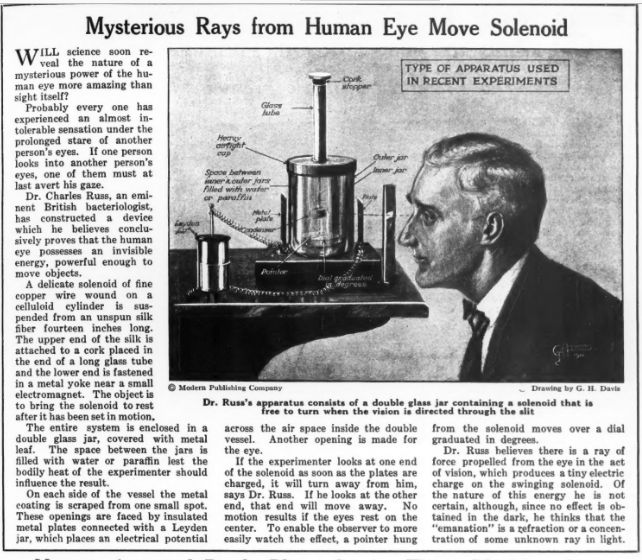
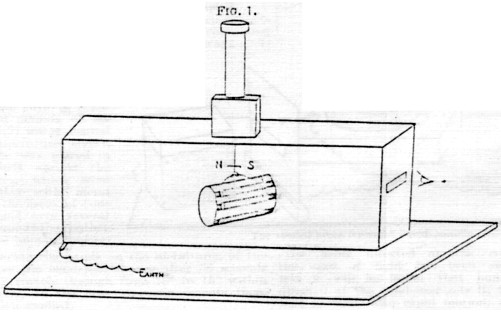
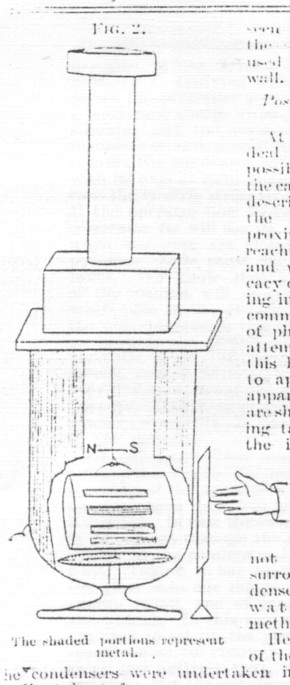
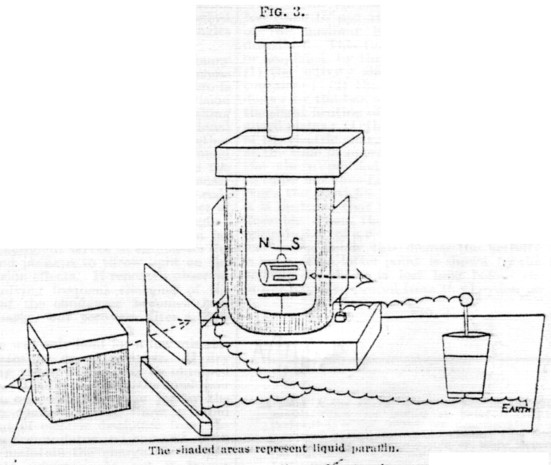
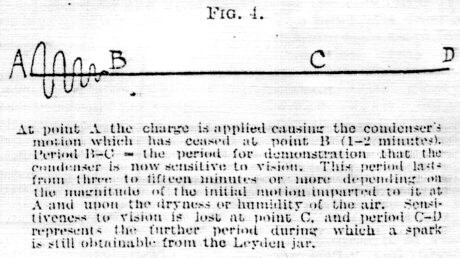
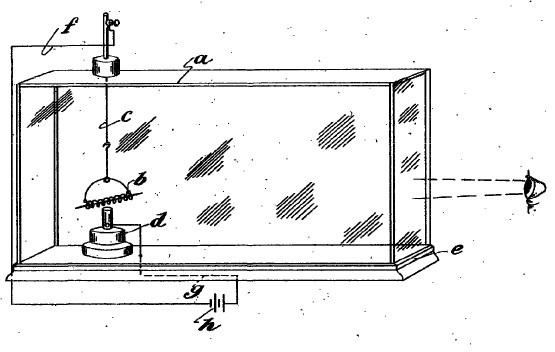
The apparatus consists of a delicate solenoid or a charged condenser suspended within a metal box. When a person gazes at the device through a slot, the solenoid or condenser is claimed to move, with direction and magnitude controlled by the observer's gaze. The effect is also enhanced by hand proximity and can be induced after charging the condenser with electrostatic means (glass rods, Leyden jar). The author reports that the motion persists for seconds to minutes and can be observed through water or glass.
Detailed Description
A solenoid wound from fine copper wire on a celluloid cylinder is suspended by a silk fiber inside an aluminum-lined metal box. A small magnet holds the solenoid in a magnetic meridian. When a human eye looks through a slot at one end of the solenoid, the solenoid moves away from the eye; looking at the opposite end reverses the motion. A larger celluloid-cylinder condenser with lead/aluminum foil layers is similarly suspended and can be set into rotation by vision, hand contact, or electrostatic charging (glass rod, Leyden jar). Various control methods (heat, water jacket, glass plates) are used to rule out thermal effects. Motion is measured by a reflected light spot on a scale.
Principles
- Electrostatic induction
- Magnetic torque
- Vision-induced force (hypothetical)
- Mechanical resonance
Scientific Domains
Materials
- copper wire
- celluloid
- silk fiber
- aluminum sheet
- glass
- steel wire
- lead foil
- aluminum foil
- gold leaf
- sulfur
- water
- paraffin
- methylated spirit
Mechanisms of Action
- Gaze-induced motion of a suspended solenoid
- Electrostatic charging of a condenser leading to rotation
- Magnetic alignment of a small magnet with the solenoid
Energy Sources
Applications
- research into human-generated radiation
- psychic or paranormal instrumentation
Claimed Performance
Solenoid motion direction controllable by gaze; rotation up to 90 deg for the condenser; motion observable through water; effect persists for minutes after initiation.
Experimental Evidence
Demonstrations to several Fellows of the Royal Society and other scientists; motion observed after direct gaze, after hand contact, and after electrostatic charging; motion reduced but not eliminated by heat; quantitative rotation angles (30-90 deg ) reported.
Replication Status
Demonstrated to experts; no independent replication reported in the article.
Limitations
- Lack of quantitative, reproducible data
- Potential thermal or mechanical artifacts
- No independent verification
Red Flags
- Extraordinary claim of an unknown physiological ray
- Reliance on subjective observation (human gaze)
- Absence of peer-reviewed quantitative data