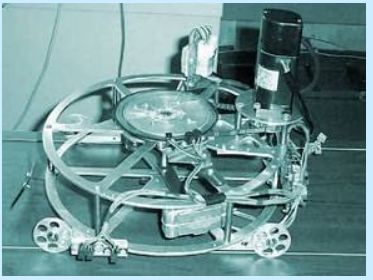
Goal
Create a reaction-less mechanical propulsion system that can generate thrust without ejecting reaction mass and operate in any medium (land, water, air, space).
Problem
Dependence on conventional reaction-mass engines, limited efficiency, and environmental impact of current propulsion technologies.
Concept Summary
The device is a four-dimensional gyroscope that uses rapid changes in rotational inertia to produce non-compensated internal inertial forces (space-time precession). These forces shift the center of mass, generating directional thrust without external reaction mass. The system is powered by an electric capacitor and can be controlled via software.
Principles
- Gyroscopic precession
- Space-time precession
- Inertial mass control
- Torsion-field interaction
Scientific Domains
Materials
- Metal components
- Oil (low-friction table)
Mechanisms of Action
- Internal non-compensated inertial forces
- Sharp change of rotational energy
- Coupling of translational and rotational inertia
Energy Sources
Applications
- Universal propulsion for land, water, underwater, air and space vehicles
- Long-distance space travel
- Ecologically clean transport
Claimed Performance
Energy efficiency 40-60 % vs. conventional jet engines 2-10 %; ability to change direction instantly; operation in land, water, underwater, air and space.
Experimental Evidence
Demonstrated thrust on a low-friction oil-coated table, pendulum experiment, low-friction roller, water environment, and a toy boat suspended on strings. Motion of the center of mass was recorded with a measuring system and real-time software.
Limitations
- No peer-reviewed quantitative data
- Claims of violating Newtonian momentum conservation
- Scalability and power-density not demonstrated
Red Flags
- Allegations of mathematical errors and false statements in Shipov's earlier work
- Claims of overunity-like efficiency without independent verification
- Potential violation of fundamental conservation laws