Goal
Store renewable electricity as high-temperature heat in sand for industrial process heat, enabling decarbonisation and reducing fossil-fuel emissions.
Problem
Industrial heat demand is largely met by fossil fuels; intermittent renewable electricity lacks a cost-effective, large-scale heat-storage solution.
Concept Summary
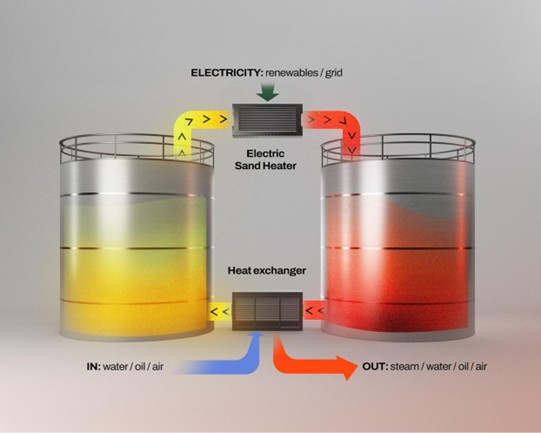
Electric heaters raise sand temperature to up to 800 deg C in a cold silo; the hot sand is stored in an insulated hot silo. When heat is needed, sand is fluidized by gas and passed through a series of heat-transfer modules, delivering steam or thermal oil with high efficiency.
Detailed Description
The proprietary system uses two insulated silos, an electric resistance heater, and a modular fluidized-solid heat exchanger. Sand particles are heated electrically, then stored in a refractory-lined chamber. For discharge, gas fluidizes the sand, allowing it to flow horizontally through adjacent heat-transfer modules where heat is transferred to a secondary fluid (steam or oil). The design claims up to tenfold higher heat-transfer efficiency than conventional static storage and is scalable from 20 MWh to 500 MWh with charging powers of 1 MW-20 MW.
Principles
- Sensible heat storage
- Fluidized solid heat transfer
- Heat exchange
- Thermal insulation
Scientific Domains
Materials
- Sand (silica)
- Refractory ceramic material
- Solid insulation particles
Mechanisms of Action
- Electric resistance heating of sand
- Thermal storage in bulk sand mass
- Gas-induced fluidization for heat transport
- Modular heat-exchange to produce steam or hot oil
Energy Sources
Applications
- Industrial process heat
- Power-plant steam generation
- District heating
Claimed Performance
Heat transfer efficiency up to tenfold higher than conventional static storage; temperature up to 800 deg C; scalable 20-500 MWh with charging power 1-20 MW.
Experimental Evidence
The article states that the system can deliver steam with up to tenfold higher heat transfer efficiency compared to conventional static storage and that it is scalable from 20 to 500 MWh with charging power from 1 to 20 MW.
Limitations
- Requires large insulated silos
- Potential heat loss over long storage periods
- Dependence on renewable electricity availability