Goal
Concentrate sunlight for solar cooking and other solar-energy applications at lower cost than conventional parabolic concentrators.
Problem
Expensive, heavy, and complex-shaped parabolic solar concentrators that are difficult to manufacture and transport.
Concept Summary
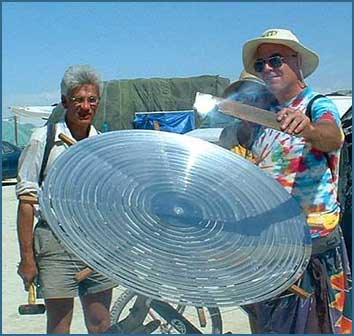
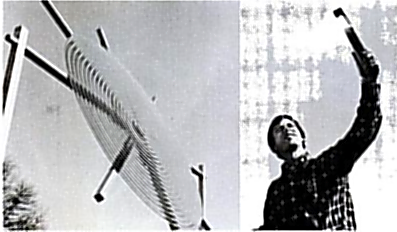
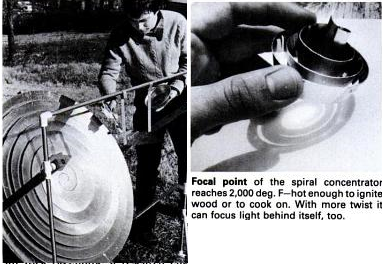
A flat sheet of reflective material is patterned with a mathematically defined spiral. The sheet is cut along the spiral and then 'wound up' so that each arm is inclined at an angle that directs incident sunlight to a common focal point. The design can be generated by a computer program, allowing control of focal length, concentration ratio, and mounting geometry. The reflector can be made from inexpensive materials such as aluminum foil, hardboard, or aluminized cardboard.
Principles
- Geometric optics
- Fresnel reflector principle
- Spiral geometry for variable inclination
Scientific Domains
Materials
- Aluminum foil
- Hardboard (Masonite)
- Aluminized cardboard
- Aluminized plastic
Mechanisms of Action
- Reflection of sunlight
- Variable inclination of spiral arms to focus light
Energy Sources
Applications
- Solar cooking
- Low-to-medium temperature steam generation
- Power generation (Brayton or Stirling cycle)
- Photovoltaic electricity generation at focal point
Claimed Performance
Can replace parabolic concentrators in many applications at much lower cost, with comparable concentration ratios.
Experimental Evidence
Nine Georgia Tech Spiral Concentrators have been built and tested for solar cooking using aluminum foil and hardboard.
Replication Status
Prototype units (nine) built; no independent third-party replication reported.
Limitations
- Requires precise cutting and accurate winding of the spiral
- Limited to flat sheet materials that can be reflective
- Scaling to very large apertures may present structural challenges