Goal
Harvest potable water from atmospheric humidity using a low-energy, solar-driven sorbent material.
Problem
Global freshwater scarcity and high energy consumption of conventional atmospheric water-harvesting technologies.
Concept Summary
A porous, biodegradable hydro-sponge (CPPY) made from chitosan, I3-polyglutamic acid, polyvinylpyrrolidone and polypyrrole is loaded with lithium chloride (or other hygroscopic salts) to create a material that adsorbs large amounts of water vapor at low humidity and releases it at modest temperatures (~=50 deg C) using only sunlight, thereby reducing the energy required for evaporation by ~40 % compared with pure water.
Detailed Description
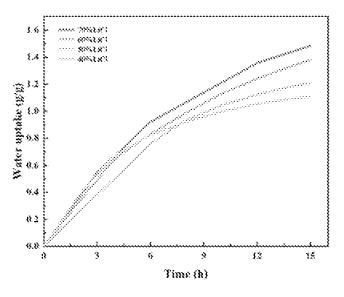
The hydro-sponge is prepared by mixing biopolymers (chitosan, I3-polyglutamic acid, PVP) with a photothermal additive (polypyrrole) and a hygroscopic salt (LiCl). Physical and chemical foaming create a highly porous network (~=70 % void volume) that facilitates vapor transport. The material stores water in three states (tightly bound, loosely bound, free) with a high proportion of loosely/free water that can be desorbed with low thermal input. Laboratory and outdoor tests show water uptake of 1.64 g/g at 30 % RH, 2.65 g/g at 60 % RH, and 4.21 g/g at 80 % RH, and a water yield of 6.29 L m^-^2 day^-^1 under natural sunlight. The harvested water meets WHO drinking-water standards. The hydro-sponge is biodegradable and requires only sunlight, making it suitable for remote, off-grid applications.
Principles
- Sorption of water vapor
- Photothermal conversion
- Porous network for rapid vapor transport
- Hygroscopic salt-induced moisture uptake
Scientific Domains
Materials
- chitosan
- I3-polyglutamic acid
- polyvinylpyrrolidone
- polypyrrole
- lithium chloride
- reduced graphene oxide
- carboxylated carbon nanotubes
- carbon black
- acrylamide
- hydroxypropyl methylcellulose
- N,N-methylenebisacrylamide
- N,N,N',N'-tetramethylethylenediamine
- ammonium persulfate
Mechanisms of Action
- Adsorption of water vapor onto hygroscopic salt sites
- Solar heating of polypyrrole to raise temperature for desorption
- Capillary and surface tension effects in porous channels
Energy Sources
Applications
- Rural drinking-water supply
- Emergency relief water provision
- Off-grid water harvesting
Claimed Performance
~=40 % lower evaporation energy than pure water; water desorption begins at 50 deg C (vs. 80 deg C for conventional sorbents); water uptake up to 4.21 g g^-^1 at 80 % RH; outdoor yield 6.29 L m^-^2 day^-^1; retains 90 % capacity after strong UV exposure.
Experimental Evidence
Laboratory adsorption tests at 30 %, 60 % and 80 % relative humidity showed uptake of 1.64, 2.65 and 4.21 g g^-^1 respectively. Outdoor overnight exposure followed by daytime collection yielded 6.29 L m^-^2 day^-^1. UV durability test demonstrated 90 % retention of water-capture ability. WHO water-safety analysis confirmed drinkability.
Limitations
- Cost of large-scale production not yet optimized
- Long-term durability under continuous solar exposure not fully demonstrated