Goal
Provide a reliable, self-powered magnetic pulse source for sensors, energy harvesting, and low-power electronic devices.
Problem
Need for low-power, speed-independent magnetic sensing and energy harvesting without external power supplies.
Concept Summary
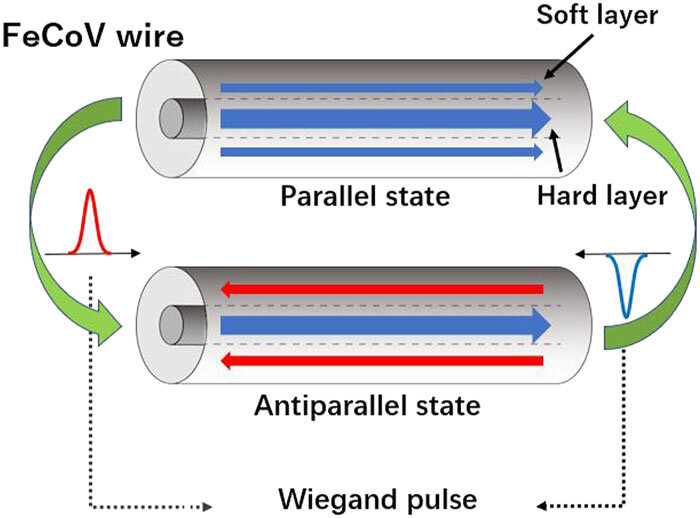
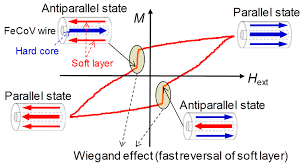
Wiegand wire is a specially cold-worked Vicalloy alloy with a high-coercivity outer shell and a soft magnetic core. When an external magnetic field exceeds a threshold, the core flips its polarity in microseconds, inducing a voltage pulse in a surrounding coil. The pulse amplitude is essentially independent of the speed of the field change, enabling self-powered sensors and energy-harvesting devices.
Detailed Description
The wire is annealed lowalloyoy is twisted andunt twisted work and aged to create a hard outer layer and a soft inner core. The resulting hysteresis causes an avalanche of domain switching in the outer shell when the external field reaches a critical value, producing a rapid magnetic reversal. A copper coil wrapped around the wire captures the changing flux, generating a short voltage pulse (~=200 nJ per pulse in commercial units, up to 10 uJ in enhanced harvesters). This effect is used in Wiegand sensors, keycard readers, rotary encoders, wheel-speed sensors, and IoT energy-harvesting nodes.
Principles
- Magnetic hysteresis
- High coercivity outer shell vs. soft core
- Avalanche domain switching
- Faraday electromagnetic induction
Scientific Domains
Materials
- Low-carbon Vicalloy (cobalt, iron, vanadium alloy)
- Copper (coil winding)
Mechanisms of Action
- External magnetic field exceeds coercivity threshold
- Core magnetization flips rapidly
- Changing magnetic flux induces voltage pulse in surrounding coil
Energy Sources
Applications
- IoT self-powered sensors
- Energy harvesting from motion
- Rotary encoders
- Wheel-speed measurement
- Security keycard access
- Tachometers for rail cars
Claimed Performance
Typical commercial Wiegand sensor pulse ~=200 nJ; enhanced harvesters up to 10 uJ per pulse, sufficient to power a low-power UWB transceiver (~=60 m range). Pulses are speed-independent and repeatable.
Experimental Evidence
Demonstrated generation of up to 10 uJ per pulse powering an ultra-wide-band radio transceiver with 60 m range; >1 million rotary encoders built using Wiegand sensors; energy-harvesting self-powered rotation counters in water/gas meters.
Replication Status
Commercially deployed in keycard access systems, rotary encoders, wheel-speed sensors, and IoT energy-harvesting modules; multiple manufacturers (POSITAL, UBITO) produce Wiegand sensors.
Limitations
- Requires specific alloy processing (cold-working, annealing)
- Limited energy per pulse (nano- to micro-joules)
- Performance depends on presence of a suitable external magnetic field