Goal
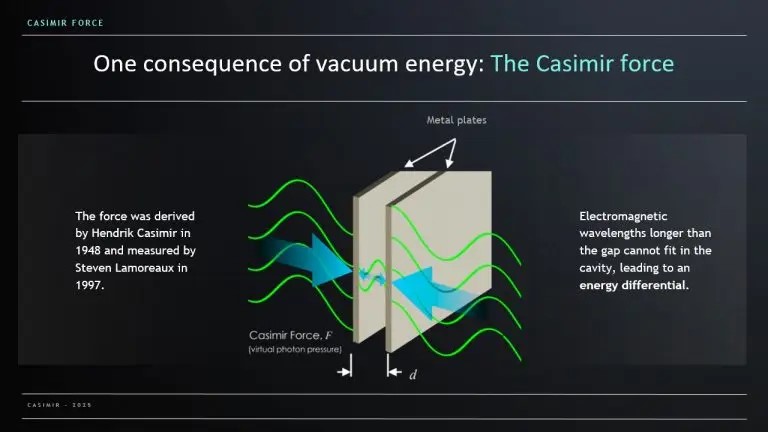
Convert quantum vacuum fluctuations (Casimir effect) into a continuous electrical power source for low-power devices.
Problem
Need for a compact, long-lasting power source that works without batteries or external fuel, especially for IoT, medical and space applications.
Concept Summary
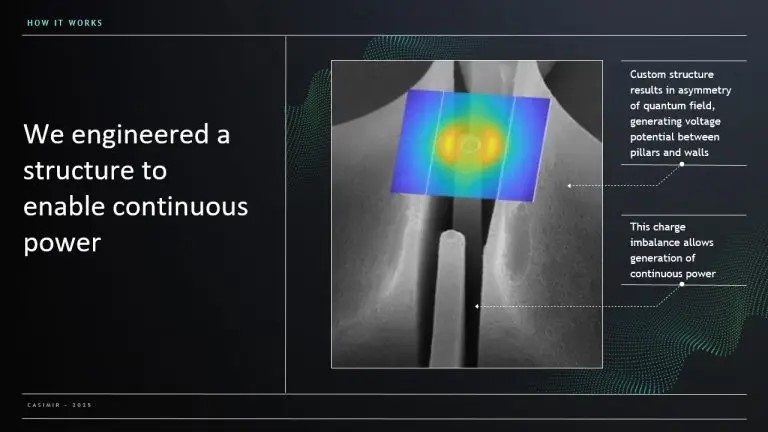
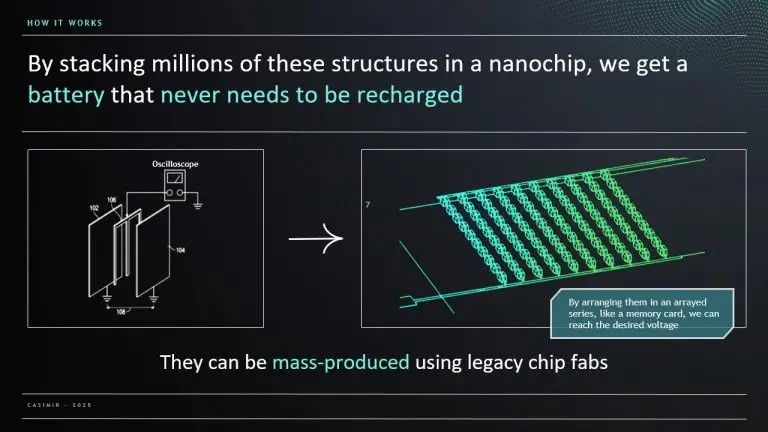
Nanostructured Casimir cavities with an array of conductive pillars create a stable electrostatic potential that harvests the repulsive Casimir force, generating micro- toatt power levels continuously.
Principles
- Casimir effect
- Quantum vacuum (zero-point) fluctuations
- Nanostructured conductive cavities
- Electrostatic potential generation
Scientific Domains
Materials
- Silicon
- Metallic conductive pillars (e.g., gold, aluminum)
- Vacuum gap
Mechanisms of Action
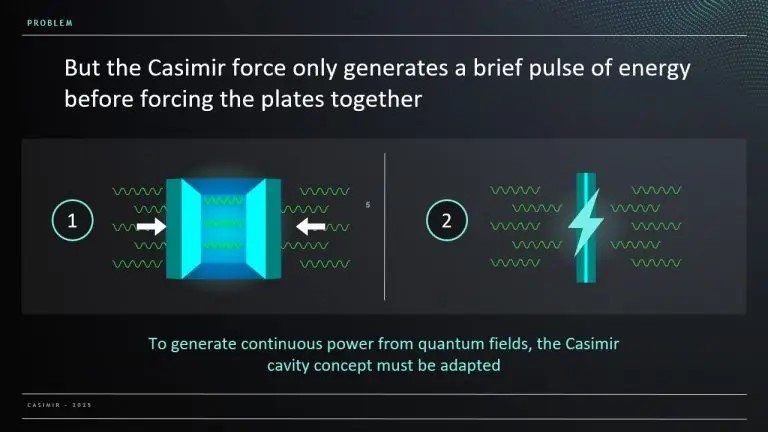
- Harvesting repulsive Casimir force between closely spaced conductive plates
- Maintaining a negative voltage on nanos relative to cavity walls to produce a steady electrostatic potential
Energy Sources
Applications
- Low-power IoT sensors
- Medical monitoring devices
- Spacecraft electronics
- Potential future propulsion concepts
Claimed Performance
150 uW per thumbnail-sized chip (~=30 mV, 5 mA); 1.5 V @ 25 uA reported in video demonstration.
Experimental Evidence
Video of a chip producing measurable voltage and current on a voltmeter; description of a 150 uW output on a chip the than a thumbnail; peer-reviewed Nature Photonics papers showing controllable Casimir forces on silicon nanostructures.
Limitations
- Very low power output (microwatts)
- Scalability to useful voltages/currents not demonstrated
- Requires nanoscale vacuum gaps and precise nanofabrication
Red Flags
- Claims of extracting usable energy from zero-point vacuum (often linked to perpetual-motion ideas)
- Lack of independent, peer-reviewed replication of the power-generation results