Goal
Provide 360 deg thrust vectoring for aircraft, improving maneuverability and reducing loads on the eccentric bearing axis.
Problem
Traditional propulsion systems deliver thrust in a single direction and suffer from high loads on the eccentric bearing axis of cyclogyro rotors, limiting maneuverability and structural durability.
Concept Summary
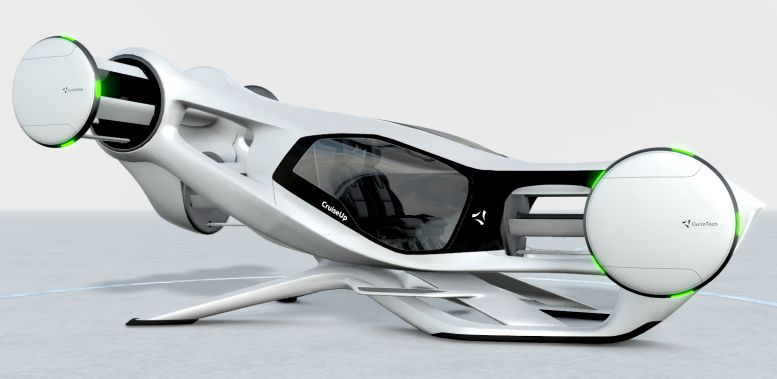
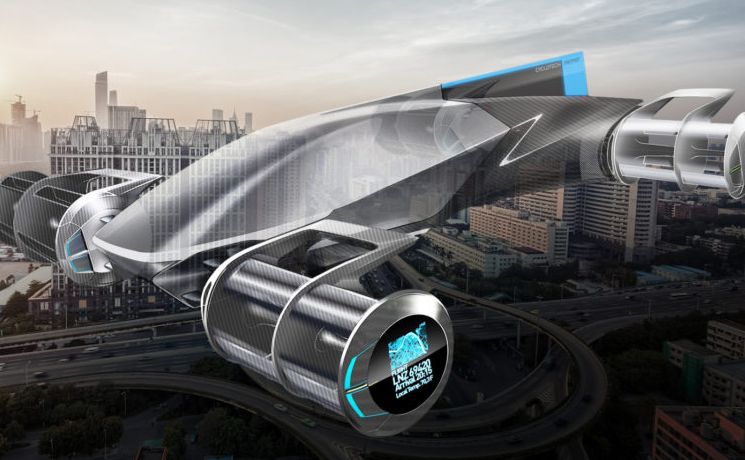
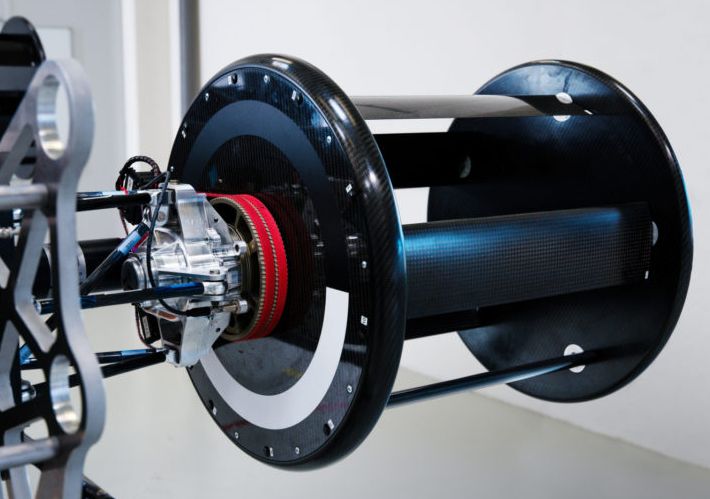
The CycloRotor is a cyclogyro-type propulsion unit whose blades rotate about an axis parallel to the aircraft longitudinal axis. A pitch mechanism, coupled via a conrod to an eccentric offset device, continuously varies blade pitch during rotation, generating thrust that can be vector-controlled through 360 deg without tilting the airframe. The design emphasizes lightweight, durable construction and an adjustable eccentric bearing axis to reduce harmonic loads.
Principles
- Thrust vectoring
- Blade pitch control
- Eccentric bearing axis
- Cyclogyro rotor aerodynamics
Scientific Domains
Mechanisms of Action
- Periodic blade pitch variation
- Eccentric offset device producing pendular blade motion
- Coupling device linking blade to offset axis
- Electrical motor driving rotor
Energy Sources
Applications
- UAV propulsion
- Urban Air Mobility
- VTOL aircraft
Claimed Performance
Efficiency more than doubled in three years; 360 deg thrust vectoring achievable within fractions of a second; fully electric CR-42 powered an entire aircraft in 2021.
Experimental Evidence
CycloTech demonstrated a fully electric CR-42 powering an entire aircraft in 2021; wind-tunnel and flight testing were performed; CFD, multi-body dynamics and FE modelling used for optimisation.
Replication Status
Demonstrated by CycloTech; no independent replication reported in the article.
Limitations
- Requires precise mechanical tolerances for eccentric bearing
- Residual loads on eccentric bearing axis may limit scalability
- Dependence on electric power source