Goal
To whiten teeth and promote remineralization of enamel and dentin.
Problem
Tooth staining and de-mineralization (cavities) caused by organic pigments and bacterial activity.
Concept Summary
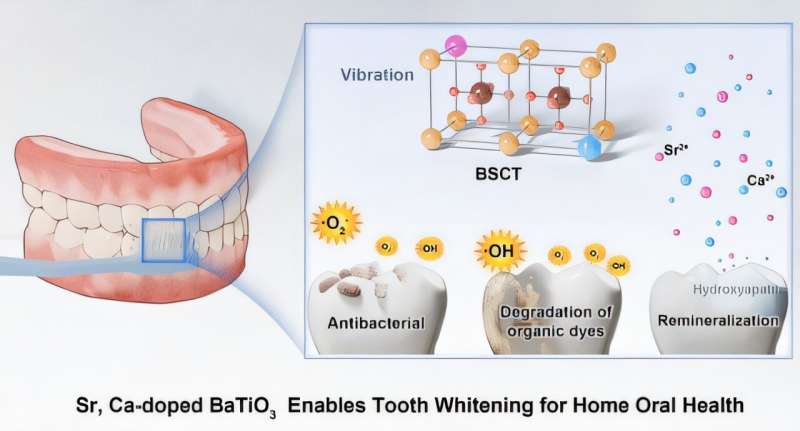
A piezoelectric ceramic powder (BSCT) containing Ba, Sr, Ca and TiO_3 is applied to teeth and activated by mechanical vibration or ultrasonic stimulation. The piezoelectric effect generates reactive oxygen species (superoxide anion, hydroxyl radicals) that degrade organic stains and inhibit cariogenic bacteria, while released Ca^2^+ and Sr^2^+ ions create ion-enriched zones that foster hydroxyapatite formation and remineralization.
Detailed Description
The invention details a sol-gel synthesis of Ba_0._9Sr_0._0_5Ca_0._0_5TiO_3 ceramic powder, followed by drying and heat-treatment (900 deg C, 2 h). The resulting ~80 nm particles exhibit a clear piezoelectric hysteresis loop. Under ultrasonic exposure (2 W, 40 min) the powder generates A*O_2^- and A*OH radicals, which were detected by ESR. In vitro tests showed fading of indigo-carmine dye, degradation of coffee/tea/tobacco stains, inhibition of bacterial membrane potential, and promotion of hydroxyapatite nucleation on enamel surfaces (XRD, SEM). Cytotoxicity assays with human gingival fibroblasts indicated good biocompatibility.
Principles
- Piezoelectric catalysis
- In-situ generation of reactive oxygen species
- Ion-release induced remineralization
- Microbial community regulation
Scientific Domains
Materials
- Barium acetate
- Strontium acetate
- Calcium acetate
- Tetrabutyl titanate
- Acetic acid
- Acetylacetone
- Ethylene glycol methyl ether
- Ba_0._9Sr_0._0_5Ca_0._0_5TiO_3 ceramic powder
Mechanisms of Action
- Mechanical vibration induces piezoelectric polarization in BSCT powder
- Polarization drives formation of superoxide anion and hydroxyl radicals
- Radicals oxidatively degrade organic stains on tooth surfaces
- Ca^2^+ and Sr^2^+ ions released from the powder promote hydroxyapatite nucleation
- Piezoelectric field disrupts bacterial membrane potential, inhibiting ATP synthesis
Energy Sources
Applications
- Home oral health care (toothpaste/ powder)
- Professional dental whitening and remineralization treatments
Claimed Performance
Active oxygen generation under ultrasonic stimulation leads to degradation of coffee/tea/tobacco stains, inhibition of cariogenic bacteria, and promotion of hydroxyapatite formation for lasting tooth whitening and mineralization.
Experimental Evidence
ESR spectra showed superoxide and hydroxyl radical peaks after ultrasonic treatment; UV-Vis absorbance at 600 nm decreased with treatment time; SEM revealed crystalline deposits on enamel; XRD detected hydroxyapatite peaks; bacterial membrane potential disruption observed; fibroblast cytotoxicity assays indicated good biocompatibility.
Replication Status
Not reported - experiments performed by the authors only.
Limitations
- Requires ultrasonic or mechanical activation to generate reactive species
- Effectiveness may depend on duration/intensity of stimulation
- Scale-up of sol-gel synthesis for consumer-grade powder needs optimization
- Long-term oral safety and microbiome impact not fully studied