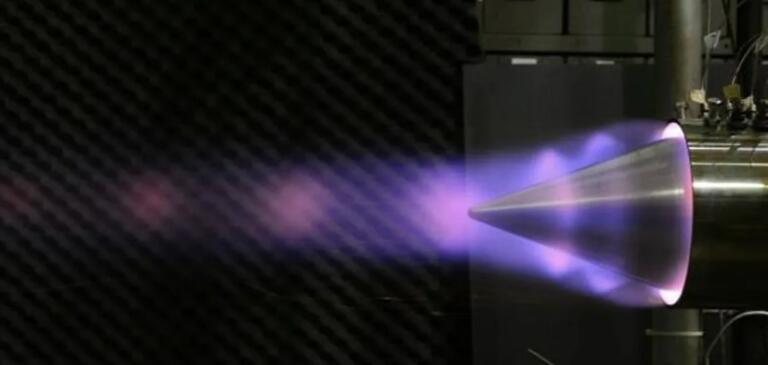
Goal
Provide a high-power, air-breathing propulsion system capable of lifting a vehicle to >30 km altitude and accelerating it to Mach 16 for hypersonic flight.
Problem
Insufficient thrust and efficiency of conventional turbine, ramjet, and scramjet engines for ultra-high-speed, high-altitude flight.
Concept Summary
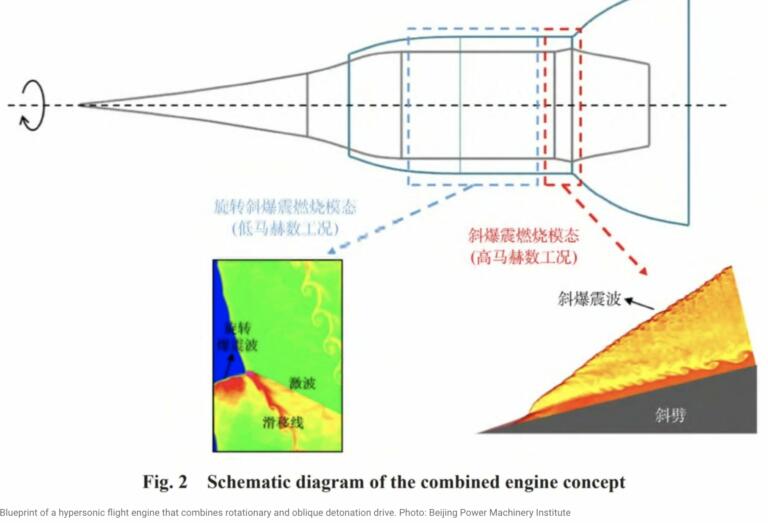
The engine combines two detonation-based modes: a rotating detonation mode for speeds below Mach 7, where a shock wave circulates in an annular chamber igniting fuel continuously, and an oblique (straight-line) detonation mode for speeds above Mach 7, where the shock focuses on a rear platform and the fuel auto-detonates. The design aims to maintain high thrust across a wide Mach range.
Detailed Description
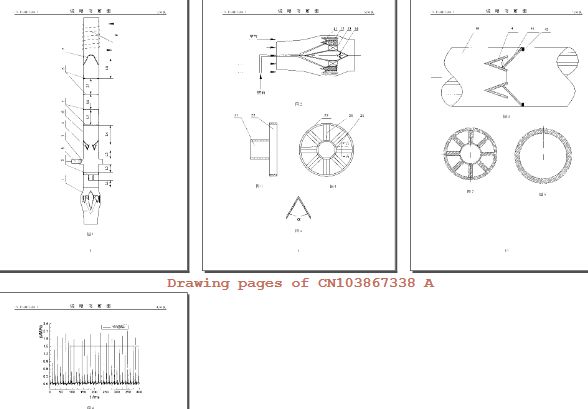
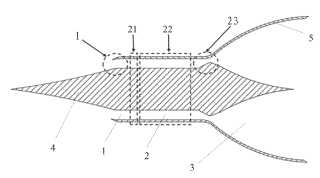
The patented design includes an inner column, a shell, and an adjustable boss structure composed of grading sections whose length and inclination vary along the flow direction. In rotating-detonation mode the grading sections are longer; in inclined-detonation mode they are shorter and angled to stabilize the oblique wave. The engine is air-breathing, mixing ambient air with hydrocarbon fuel, and relies on supersonic shock-induced combustion to convert chemical energy to kinetic energy.
Principles
- Detonation combustion
- Rotating detonation wave
- Oblique (stationary) detonation wave
- Air-breathing propulsion
Scientific Domains
Materials
- Combustible gases (hydrocarbon fuel)
- Air (oxidizer)
Mechanisms of Action
- Shock-wave induced auto-ignition of fuel
- Continuous rotating detonation for thrust generation
- Stationary oblique detonation for high-Mach thrust
Energy Sources
Applications
- Hypersonic aircraft
- Hypersonic missile propulsion
Claimed Performance
Engine can lift an aircraft to >30 km altitude and continuously accelerate it to Mach 16; theoretical chemical-to-kinetic conversion efficiency up to ~80 % (vs. 20-30 % for conventional turbofans).
Experimental Evidence
The peer-reviewed paper describes the design and provides theoretical estimates; no quantitative test data or flight demonstrations are reported.
Replication Status
No independent replication or flight testing reported.
Limitations
- Transition between rotating and oblique modes is challenging near Mach 7
- Critical engineering parameters (e.g., airflow path dimensions) not disclosed
- Stability of detonation waves at high Mach numbers
Red Flags
- No experimental efficiency data provided
- Key design parameters omitted, limiting practical engineering