Goal
To remove salts and other solutes from water by tunable ion sieving, enabling desalination and water purification.
Problem
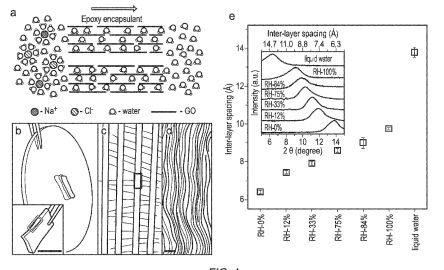
Conventional graphene oxide membranes swell in water, giving a pore size (~9 Angstrom) larger than hydrated ions, limiting ion sieving and desalination performance.
Concept Summary
Physical confinement of graphene oxide laminates reduces interlayer spacing (d) from ~13.5 Angstrom to 6.4-9.8 Angstrom, creating size-exclusion nanocapillaries that reject hydrated ions while allowing water to pass with little resistance. The method yields membranes with ~97 % NaCl rejection and scalable fabrication.
Detailed Description
The invention uses graphene oxide flakes stacked in parallel to form a laminate. By encasing the laminate with a rigid, porous encapsulating material (or by other confinement techniques) the swelling in water is limited, fixing the interlayer spacing. Membranes with spacings of 9.8 Angstrom down to 6.4 Angstrom are produced, providing a sieve smaller than the hydrated radii of common ions. Ion permeation follows thermally activated kinetics with energy barriers of 10-100 kJ mol^-^1, while water flux is only modestly reduced (factor < 2). A simple scalable production method is described, and laboratory tests show 97 % rejection of NaCl.
Principles
- Size-exclusion (nanopore sieving) based on interlayer spacing
- Capillary-like pressure driving water flow in graphene nanocapillaries
- Thermally activated ion transport barriers
Scientific Domains
Materials
- Graphene oxide
- Encapsulating polymer (porous)
- Water
Mechanisms of Action
- Physical confinement to control interlayer spacing
- Nanocapillary flow with low friction for water
- Electrostatic and steric exclusion of hydrated ions
Applications
- Seawater desalination
- Brackish water treatment
- Industrial wastewater purification
- Radioactive waste decontamination
Claimed Performance
~=97 % NaCl rejection; water transport reduced by < 2x compared with unconstrained membranes; ion permeation barriers 10-100 kJ mol^-^1.
Experimental Evidence
Laboratory membranes with d = 6.4-9.8 Angstrom demonstrated tunable ion sieving and 97 % NaCl rejection; ion permeation rates decreased exponentially with decreasing d while water flux changed little.
Replication Status
Demonstrated at laboratory scale in the reported studies; no independent large-scale replication mentioned.
Limitations
- Control of swelling under varying humidity
- Long-term mechanical stability of encapsulated laminates
- Scale-up of confinement process