Goal
Provide a dry, pressure-free access channel from the surface to a point beneath a water body, allowing personnel to descend without diving suits.
Problem
Traditional diving exposes personnel to high hydrostatic pressure and low temperatures, limiting operation time and risking injury.
Concept Summary
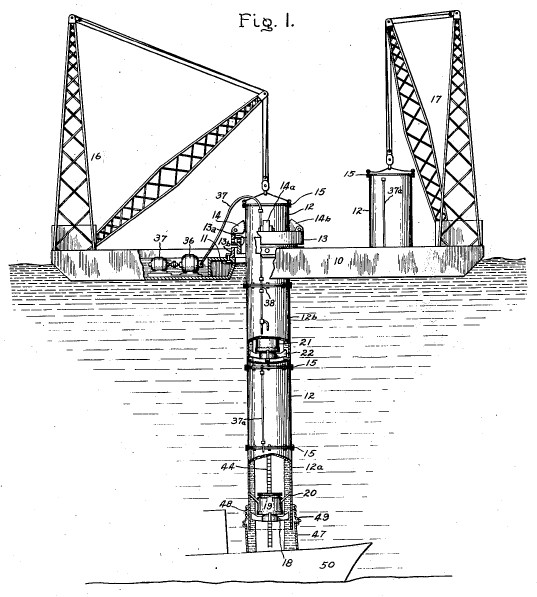
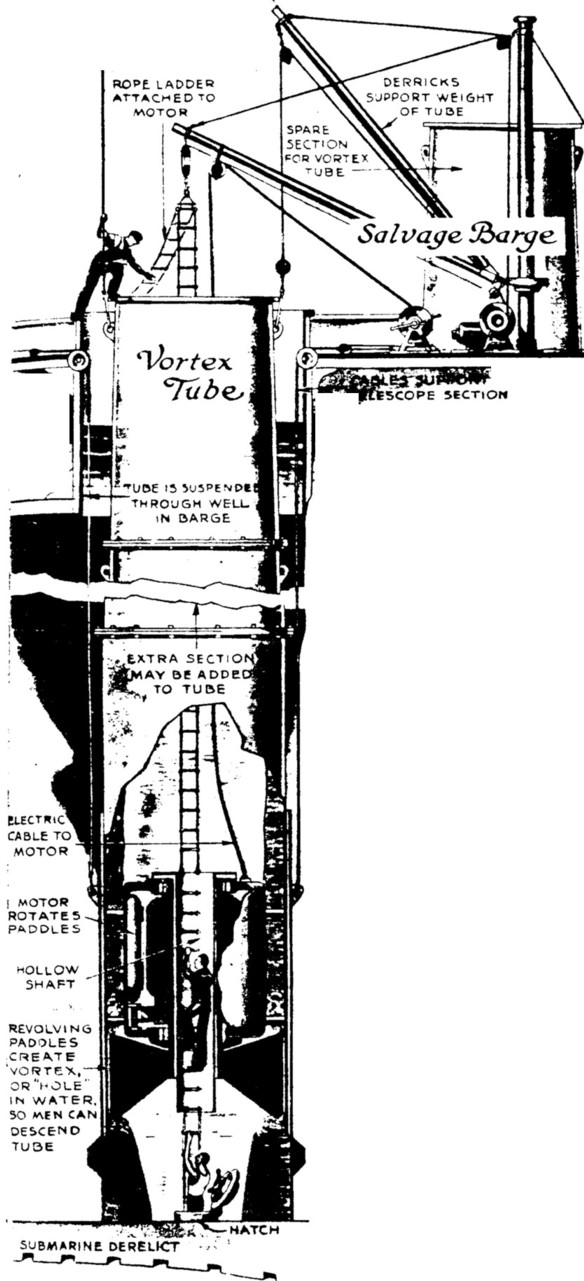
A telescopic tubular enclosure is lowered from a barge into the water. Motor-driven paddle wheels rotate the water inside the tube at high speed, creating a centrifugal vortex that clears a central column of water. A ladder runs through the hollow shaft, allowing a person to descend the dry, atmospheric-pressure shaft while the surrounding water is churning.
Detailed Description
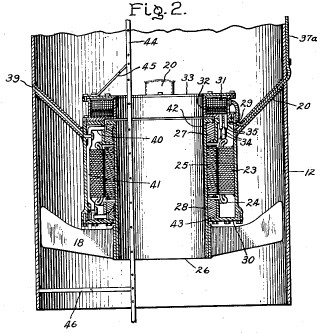
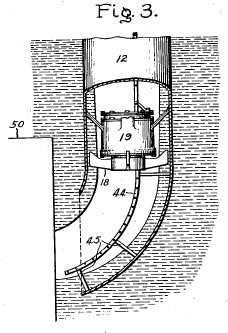
The apparatus consists of a series of tubular sections joined together and supported by a gimbal-mounted frame on a barge. Each section houses an alternating-current induction motor coupled to a paddle wheel that impels water radially outward. The rotating water forms a stable vortex, producing a low-pressure core that remains clear of water. Lignum-vitae bearing blocks lubricated by water support the motor shafts. Electrical power is supplied from a generator on the barge, stepped down by a transformer, and distributed to the motors via submarine cable. A ladder inside a hollow central shaft provides a dry passage for a diver, while the vortex prevents water ingress. The system can be assembled in sections, lowered, and operated at depths sufficient to reach sunken vessels or the sea floor for rescue, salvage, or marine harvesting.
Principles
- Centrifugal force
- Vortex dynamics
- Bernoulli principle
- Hydraulic propulsion
Scientific Domains
Materials
- Steel (tubular sections)
- Lignum vitae (bearing blocks)
- Copper (windings, cables)
- Insulating rubber bushings
- Aluminum (motor housing)
- Polyphase winding insulation
Mechanisms of Action
- Rotating paddle wheels impart angular momentum to water
- Centrifugal force pushes water outward, creating a central void
- The vortex maintains a dry column for personnel descent
- Electrical motors drive the impellers
Energy Sources
Applications
- Submarine rescue
- Underwater salvage
- Marine harvesting (oysters, seaweed)
- Hydraulic prospecting
Claimed Performance
Enables a person to descend through a dry shaft to a sunken submarine or sea-floor site without wetness and at normal atmospheric pressure; can be used for rescue, salvage, and marine product collection.
Limitations
- Requires a large barge and power generation equipment
- Depth limited by motor power and structural stability
- Vortex stability may be affected by rough sea conditions
- Complex assembly of tubular sections