Goal
Reduce aerodynamic skin-friction drag on aircraft surfaces
Problem
High drag caused by turbulent boundary-layer bursts on smooth aircraft skins
Concept Summary
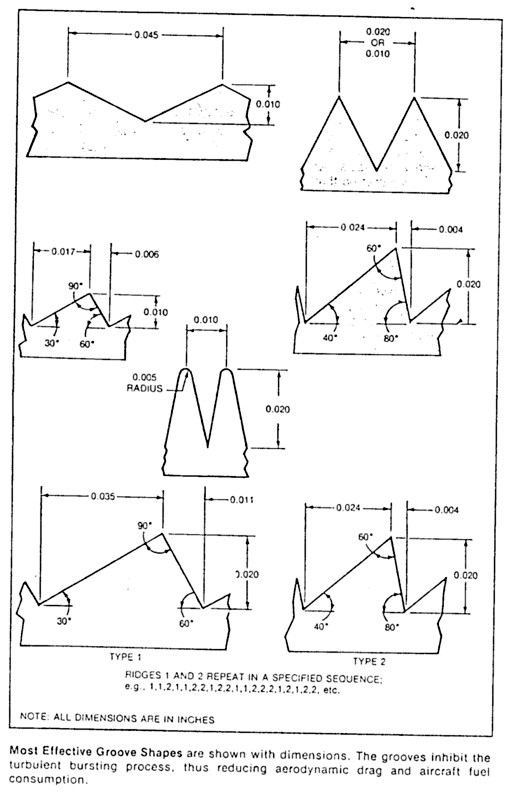
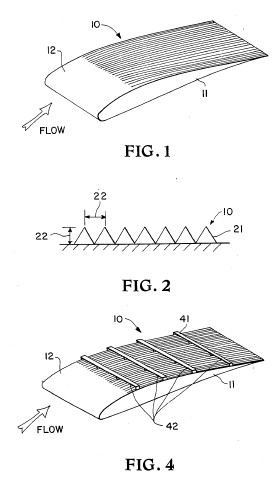
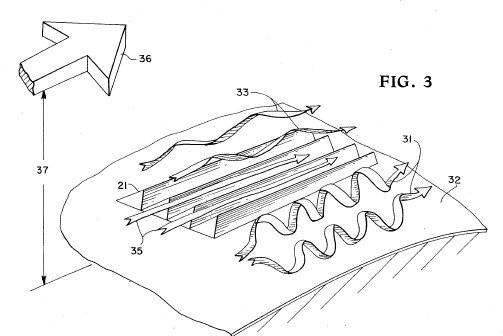
Machined V-shaped longitudinal grooves (riblets) of sub-wall-vortex dimensions confine incipient turbulence, preventing its expansion and thereby lowering skin-friction drag by 4-7 %.
Detailed Description
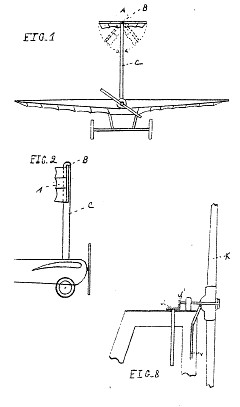
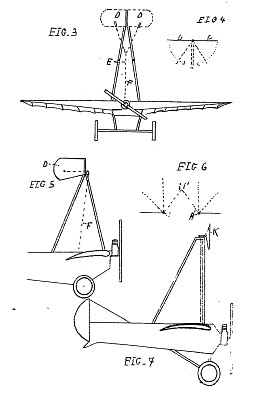
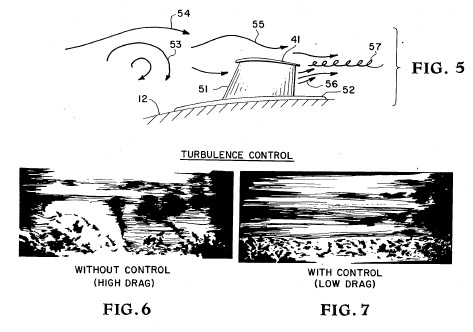
The invention consists of a series of V-shaped grooves machined into the aircraft skin. The grooves are less than 30 um high and spaced less than 40 um (in wall-units). By matching the size of the wall vortices, the grooves suppress large-scale turbulent bursts, maintaining a smoother boundary layer. The system may be combined with a small strip/airfoil suspended in the upper boundary layer to break up larger eddies, further reducing drag.
Principles
- Boundary-layer control
- Turbulence suppression
- Riblet effect
Scientific Domains
Materials
- Aluminum alloy skin
- Titanium or steel for strip (optional)
Mechanisms of Action
- Groove geometry confines turbulent bursts
- Riblet dimensions disrupt wall-vortex formation
- Upper-layer strip breaks large-scale vortices
Applications
- Commercial aircraft fuel-efficiency improvement
- Unmanned aerial vehicle (UAV) performance enhancement
Claimed Performance
Drag reduction of 4 %-7 % observed in wind-tunnel experiments
Experimental Evidence
Experiments at Langley Research Center showed the quoted drag reduction for grooves parallel to the flow
Limitations
- Manufacturing precision required for groove geometry
- Effectiveness limited to certain Reynolds-number regimes