Goal
Automatically raise water from a lower level to a higher level without external power, using only the energy of a flowing stream and atmospheric pressure.
Problem
Irrigation, rural water supply, and water provision in arid or remote areas where conventional pumps are unavailable or inefficient.
Concept Summary
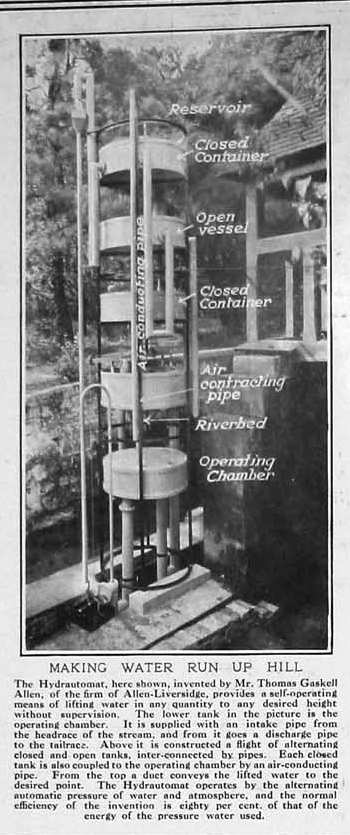
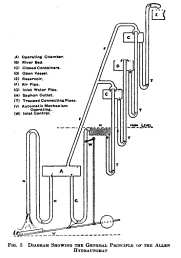
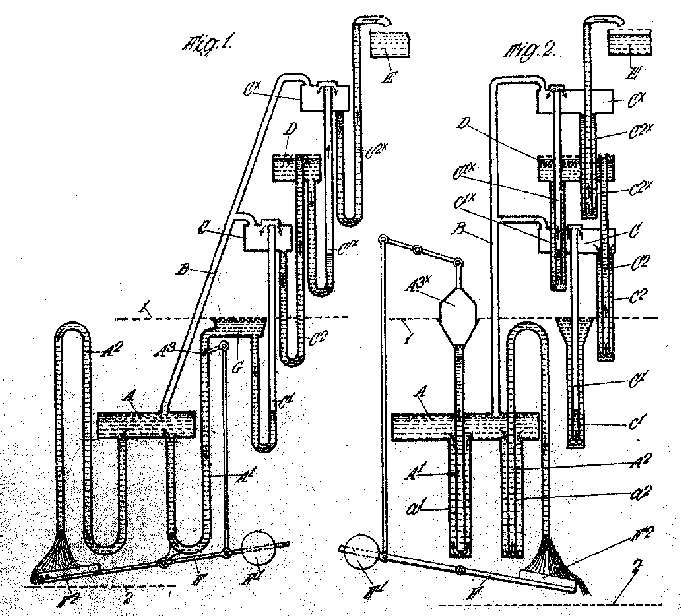
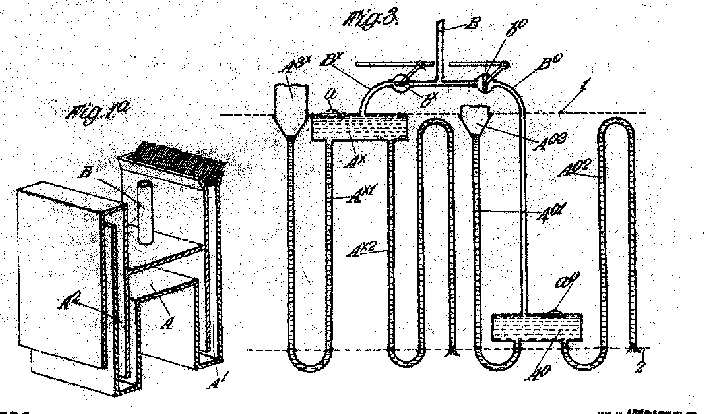
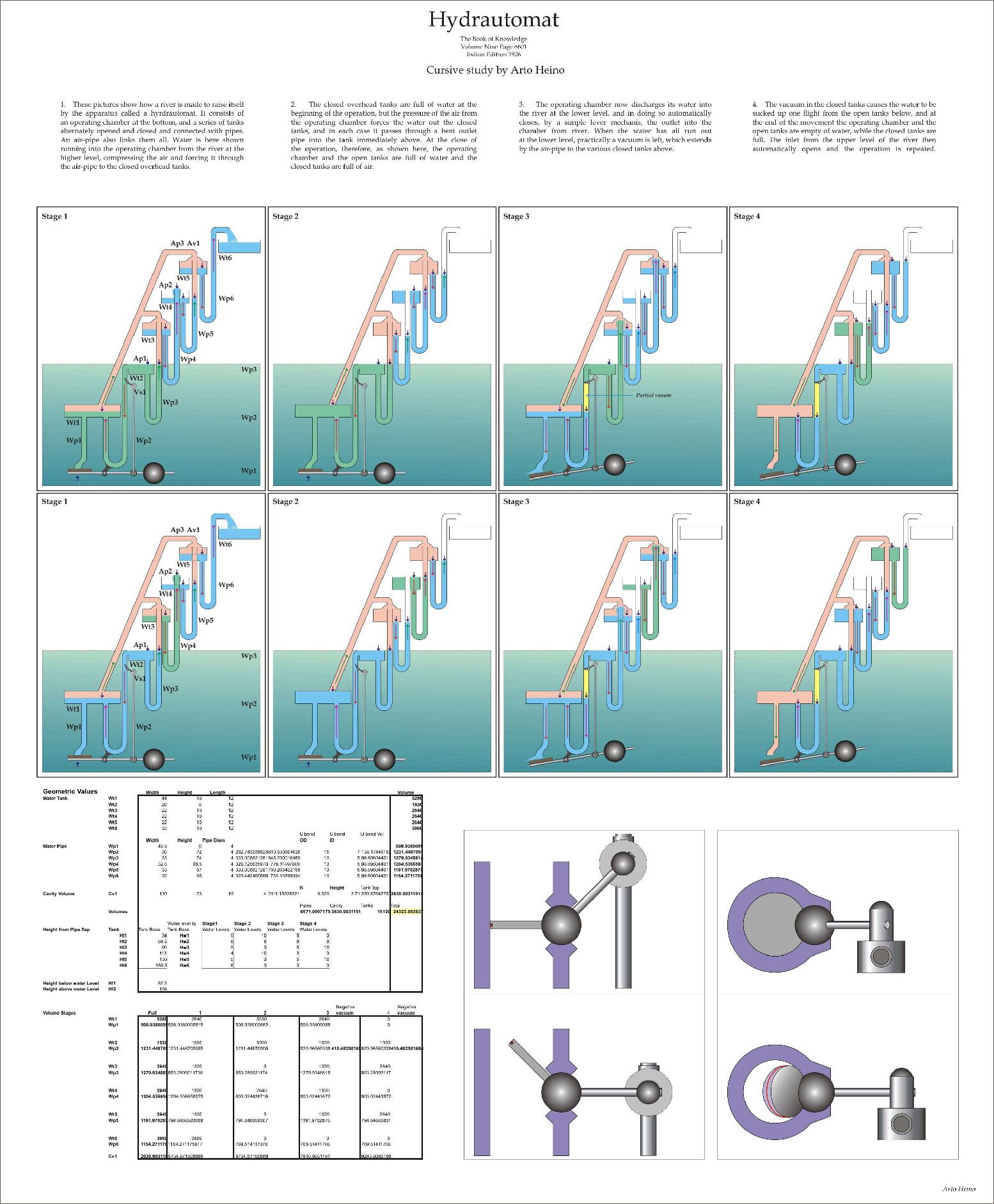
The Hydrautomat consists of a series of alternating open and closed tanks stacked vertically. An airtight operating chamber between the upper and lower levels is alternately pressurised by water flow (pressure stroke) and evacuated by a siphon (suction stroke). The pressure stroke compresses air and forces water into closed tanks; the suction stroke creates a vacuum that draws water from lower open tanks into the closed tanks, which then empty into the next higher open tanks. Repeating the cycle lifts water step-by-step, much like a hydraulic ram combined with atmospheric-pressure actuation.
Detailed Description
Water from a stream enters an open intake tank located about 7.5 ft above the device's lowest point. The intake feeds an airtight operating chamber through a pipe. During the pressure stroke, water flowing into the chamber compresses the trapped air, pushing it up an air pipe into two closed, water-filled tanks. Those tanks then discharge their water into the next higher open tanks. When the chamber empties through a discharge pipe, a valve closes the inlet and a siphon creates a vacuum that extends to the closed tanks, pulling water up from the lower open tanks. The inlet valve re-opens, the cycle repeats, and water is lifted continuously. The system relies solely on the gravitational head of the stream and atmospheric pressure; no external pumps or electricity are required.
Principles
- Hydraulic ram principle
- Atmospheric pressure differential
- Siphon-induced vacuum
- Gravity head
- Valve actuation by water flow
Scientific Domains
Materials
- Metal (tank shells)
- Plastic (fittings and bulkhead)
- Rubber (seals and valve gaskets)
- Glass (inspection windows, if any)
Mechanisms of Action
- Pressure stroke compresses air and pushes water into closed tanks
- Suction stroke creates vacuum via siphon, drawing water from lower tanks
- Valve automatically closes inlet during discharge and opens during intake
Energy Sources
Applications
- Small-scale irrigation
- Remote water supply for farms and villages
- Supplementary lift for hydro-electric installations
Claimed Performance
Raises 14 gallons of water 20 ft in less than 3 minutes; a later report claims >70 000 gallons per day from a three-foot-diameter model.
Experimental Evidence
Historical working model demonstrated in 1922-1925; replicated and documented on YouTube by Michael Sipos; contemporary newspaper and Nature article descriptions; photographs of the device.
Replication Status
Replicated and improved by Michael Sipos (2020s) with video documentation.
Limitations
- Requires a minimum water head (~7 ft) to operate
- Limited flow rate compared to powered pumps
- Sensitive to air leaks and valve wear
- Performance depends on steady stream flow