Goal
Provide a safer and more efficient water propulsion system and generate electricity using inertial and hydraulic principles.
Problem
Conventional propellers are hazardous and relatively inefficient; existing generators claim low efficiency and high cost.
Concept Summary
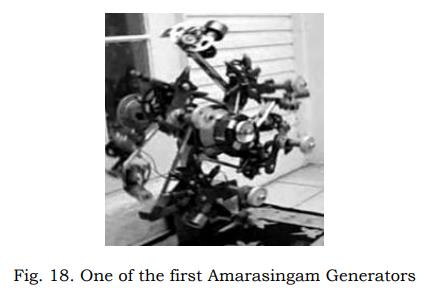
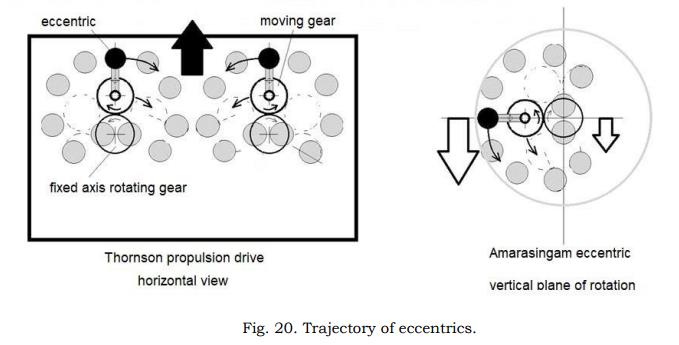
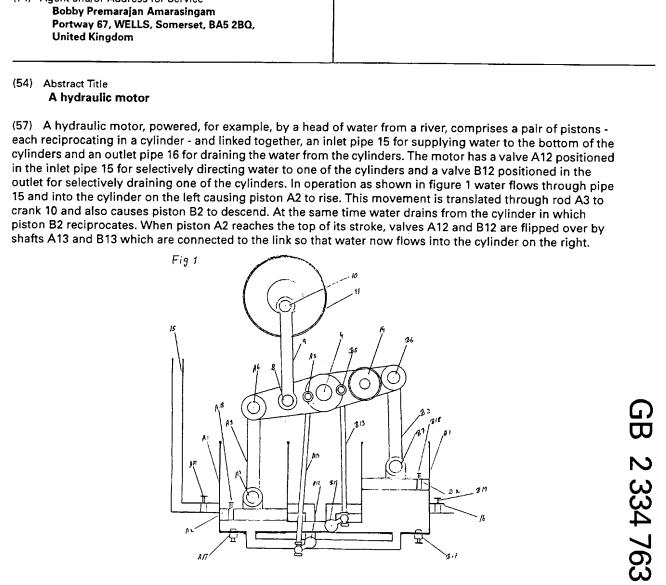
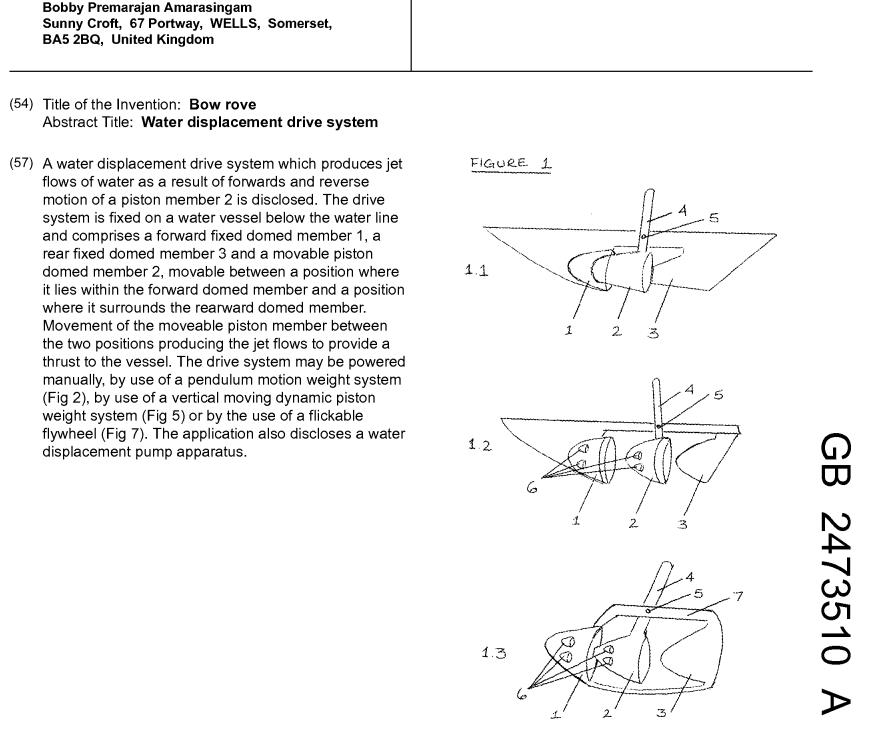
The invention combines a hydraulic motor with reciprocating pistons and an inertial generator that uses eccentrically mounted weights moving on a cardioid trajectory. The motor creates thrust by moving a piston back and forth, producing water jets. The generator claims to produce far more electrical power than the input power by exploiting inertial and gyroscopic effects.
Principles
- Reciprocating piston motion
- Water jet thrust
- Inertial torque from eccentric masses
- Cardioid trajectory of rotating weights
- Centrifugal force and gyroscopic effects
- Hydraulic pressure conversion
Scientific Domains
Materials
- Steel
- Aluminum
- Water
Mechanisms of Action
- Piston reciprocation displaces water to generate thrust
- Eccentric weights create additional torque during rotation
- Centrifugal forces amplify kinetic momentum
- Gyroscopic effects produce continuous torque on the generator rotor
Energy Sources
Applications
- Marine vessel propulsion
- Swimming pool safety devices
- Portable electricity generation
Claimed Performance
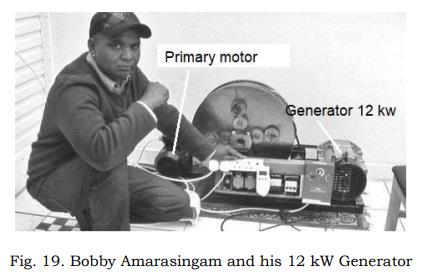
Motor claimed ~60% more efficient than conventional propellers; generator claimed 12 kW output from ~50 W input (~=200x efficiency).
Experimental Evidence
Prototype toy motor was popular at beaches; AOGFG 12 kW generator tested in Dec 2010 delivering 12 kW while consuming ~50 W after start-up; Rolls-Royce engineers reported testing the device.
Limitations
- No mass-production or commercial deployment reported
- Efficiency claims lack independent peer-reviewed data
- Potential overunity claims raise skepticism
Red Flags
- Overunity / free-energy claim
- Absence of independent replication or peer-reviewed studies