Goal
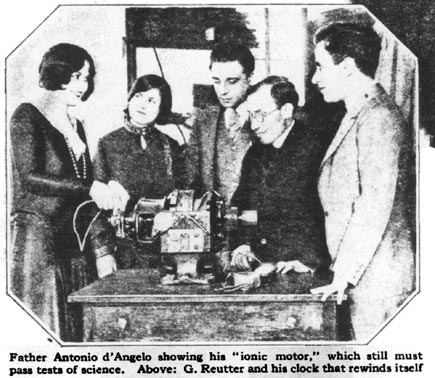
Amplify the power obtained from an electric battery to supply lighting, heating, and propulsion with a motor that claims to generate many times the input power.
Problem
Low-efficiency power conversion from batteries and the need for cheap, portable electrical power for homes and transportation.
Concept Summary
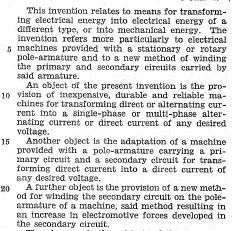
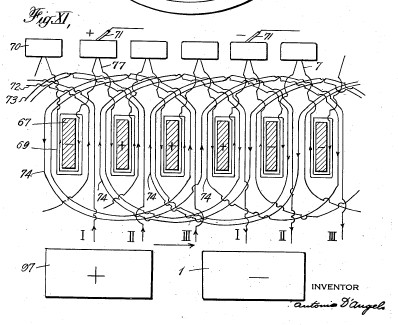
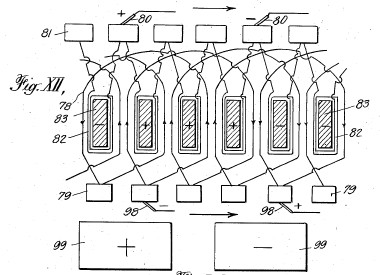
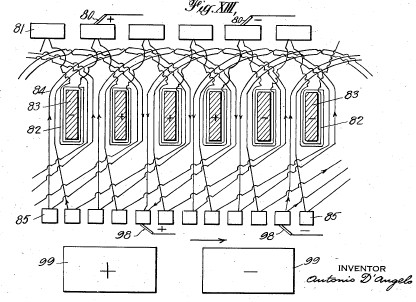
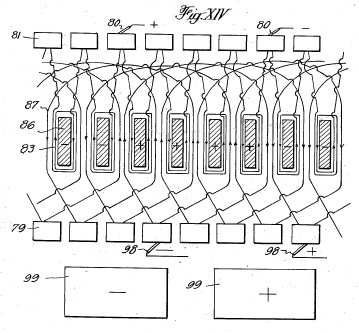
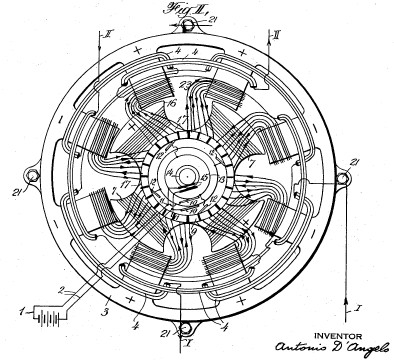
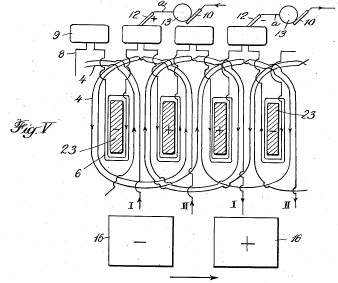
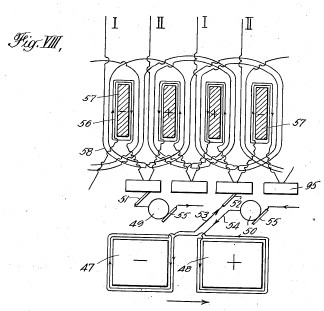
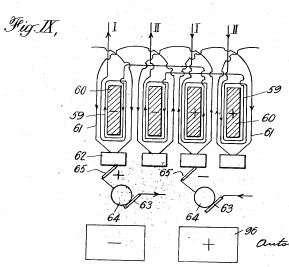
The motor-generator uses a stationary pole-armature and a rotor with primary and secondary windings of different pitch. The secondary windings encircle multiple poles, causing rapid flux changes that induce a higher electromotive force than the input battery voltage. The inventor attributes the excess power to "inter-atomic ion energy" released by the ions within the machine.
Detailed Description
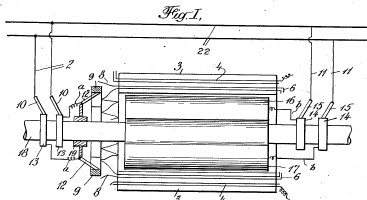
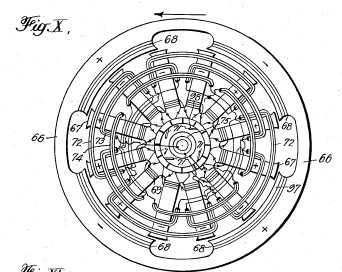
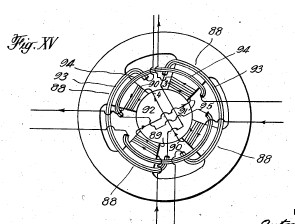
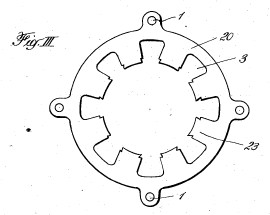
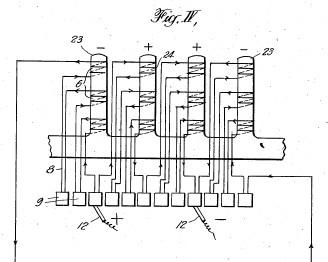
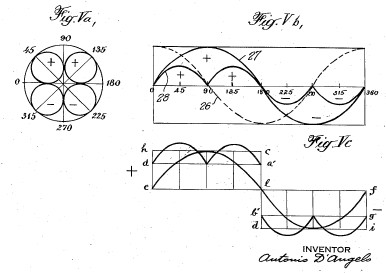
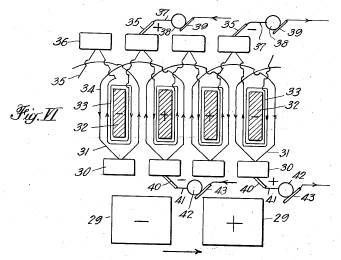
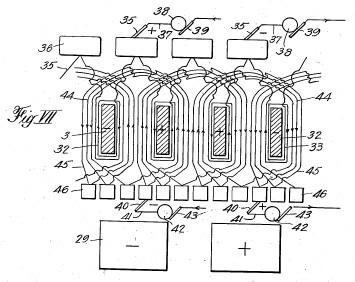
The invention comprises a stationary armature made of insulated soft-iron sheets with eight long poles and a rotor with four poles. The primary winding is wound on the stator poles with a short pitch, while the secondary winding has a much larger pitch and each turn encircles two or more poles. Direct current from a battery is supplied to the rotor windings via slip-rings and brushes; the rotating magnetic field of the rotor cuts the secondary windings, inducing a voltage that is claimed to be several times larger than the input. The patent describes a method of winding that reduces self-induction and sparking, and outlines several configurations for converting DC to AC, stepping voltage up or down, and producing multi-phase output. The inventor calls the additional energy source "inter-atomic energy of the ions," but provides no physical mechanism beyond this description.
Principles
- Electromagnetic induction
- Magnetic flux variation
- Differential winding pitch
- Inter-atomic ion energy (claimed)
- Self-induction reduction
Scientific Domains
Materials
- Soft iron sheets
- Insulated copper wire
- Bolts
- Commutator segments
- Slip-rings
- Brushes
Mechanisms of Action
- Rotating magnetic field cuts secondary windings
- Flux linkage changes induce EMF
- Secondary winding pitch increases induced voltage
- Ion energy conversion (claimed)
Energy Sources
Applications
- Home electrical lighting
- Domestic heating
- Rail locomotives
- Aircraft propulsion
- Automobile power
Claimed Performance
Produces many times the power it receives from the battery; capable of powering lighting, heating, trains, airplanes and automobiles.
Experimental Evidence
Demonstrated to the U.S. Patent Office in 1928; no quantitative data or independent testing reported.
Limitations
- No quantitative performance data
- Unverified claim of inter-atomic ion energy
- No independent replication
- Potential violation of energy conservation
Red Flags
- Extraordinary free-energy claim without experimental evidence
- Vague description of the ion energy mechanism
- Lack of peer-reviewed data or independent testing