Goal
Generate stable nanobubbles in liquids to improve water purification, aquaculture health, medical treatments, and heat transfer.
Problem
Norovirus contamination in oysters, cell damage during freezing, inefficient gas dissolution in water, need for low-energy water treatment.
Concept Summary
A carbon-ceramic porous medium driven by low-pressure gas (<=29 psi) releases gas through osmosis, creating ultrafine (nanometer-scale) bubbles that remain suspended in liquid. The system works without moving mechanical parts, can dissolve any gas (oxygen, ozone, CO_2, etc.) into any liquid, and claims a 90 % gas-transfer efficiency, double the bubble output of competing technologies.
Detailed Description
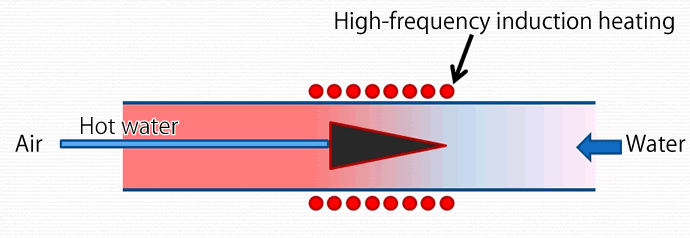
The invention uses a carbon-ceramic diffuser head (or graphite-non-metal composite) that is placed in a liquid flow channel. Gas is pumped at low pressure into the porous medium; the gas diffuses out as nanobubbles while the liquid passes through. The bubbles stay suspended because of their small size and negative-ion compression at the gas-liquid interface. Variants include in-line, rotary/propeller, and ultrasonic delivery. Patented designs cover aquaculture, wastewater treatment, fish anesthesia, hydrometallurgy, shower systems, ozone-rich water production, and cosmetic manufacturing.
Principles
- Osmosis-driven gas diffusion through a porous carbon-ceramic medium
- Nanobubble stability due to surface tension and ion compression
- Low-pressure gas injection (<=29 psi)
- High gas-transfer efficiency (~=90 %)
Scientific Domains
Materials
- Carbon ceramic
- Graphite
- Non-metal composite
- Porous carbon-based material
Mechanisms of Action
- Porous carbon ceramic allows gas to escape as nanobubbles
- Nanobubbles increase dissolved gas concentration and surface area
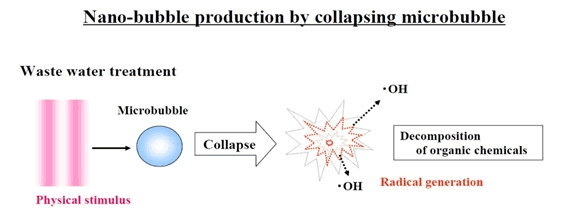
- Ozone-containing bubbles provide oxidative disinfection
- Heat transfer enhancement via large liquid-vapor interface area
Energy Sources
Applications
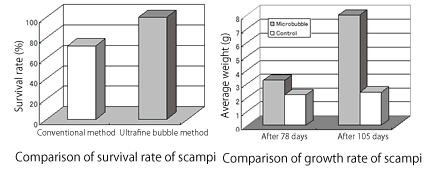
- Aquaculture disease control
- Wastewater treatment
- Medical therapies (cancer, infections)
- Water purification and sanitation
- Heat-transfer fluids
- Cosmetic manufacturing
Claimed Performance
90 % gas transfer/saturation rate in a single pass, double the bubble output of competing systems; effective removal of noroviruses from oysters; preservation of cell structure during freezing.
Experimental Evidence
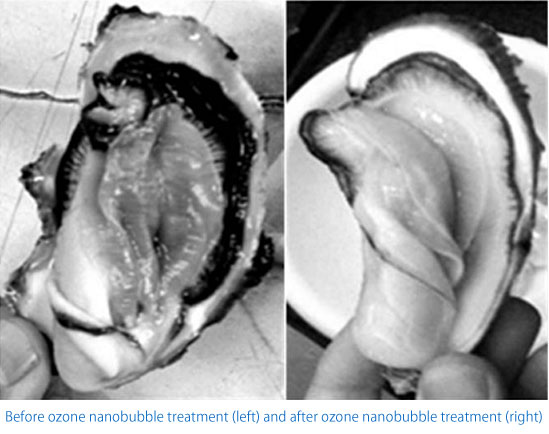
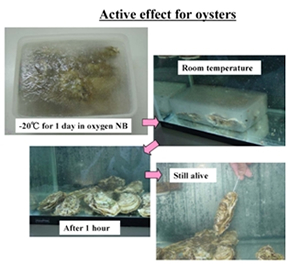
Research paper by Prof. Masayoshi Takahashi (National Institute of Advanced Industrial Science and Technology) reports that oysters frozen at -20 deg C and later thawed in nanobubble-treated seawater retained cell integrity and revived successfully.
Replication Status
Patents filed in Japan, US (US 8,919,747 B2), and Europe; commercial units sold by Nanobubble Solutions Ltd.; no independent peer-reviewed replication reported.
Limitations
- Requires continuous gas supply
- Performance data limited to company-provided tests
- No large-scale independent validation yet
Red Flags
- Medical benefit claims lack clinical trial evidence
- Heavy reliance on proprietary carbon-ceramic material without disclosed composition