Goal
To nullify or reverse the gravitational mass of a body using ELF electromagnetic fields, enabling propulsion and super-luminal travel.
Problem
Inability to control gravity for propulsion and to achieve high-speed space travel.
Concept Summary
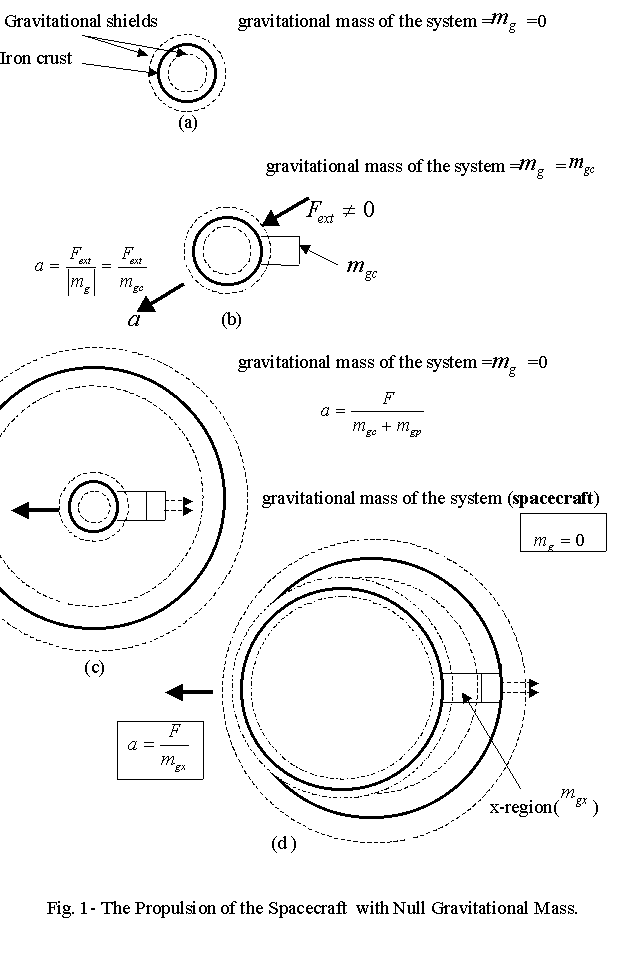
The device uses extremely low frequency (ELF) electromagnetic radiation generated by a dipole antenna that is absorbed by an annealed iron lamina (or aluminum foil). According to the author's theory, the ELF field creates a photon shield that blocks graviton exchange, making the gravitational mass of the object effectively zero. With zero gravitational mass, a small thrust (e.g., 10 N) can produce large accelerations, allowing a spacecraft to exceed the speed of light.
Detailed Description
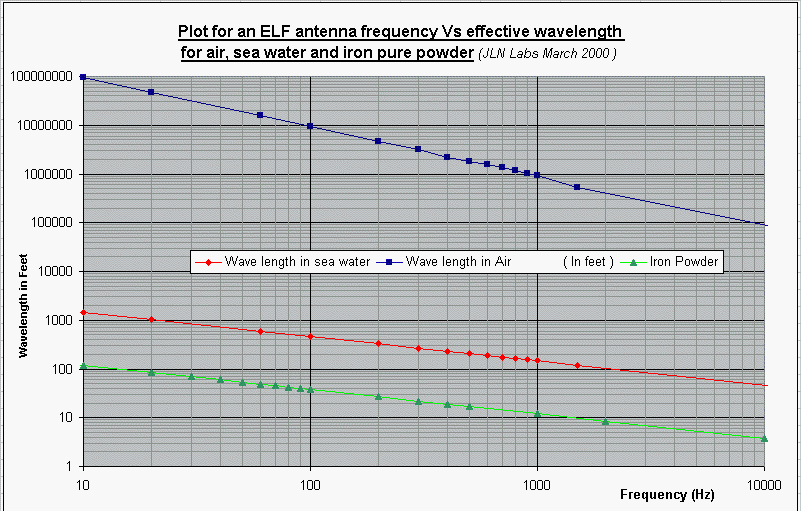
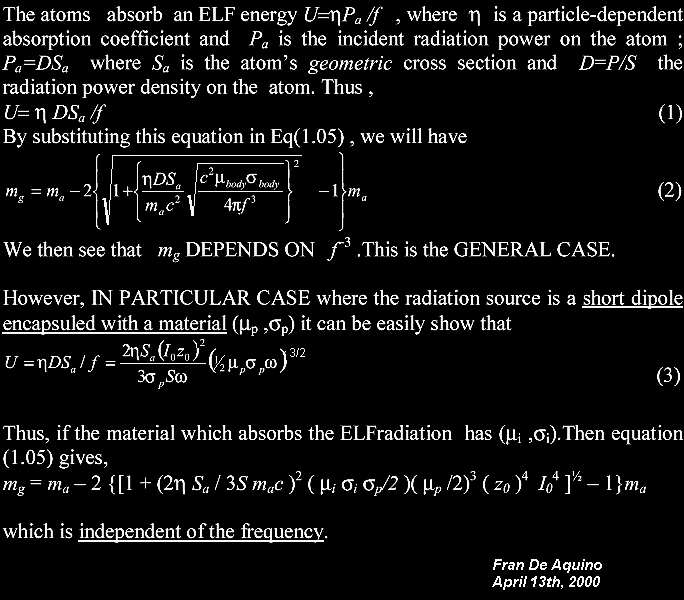
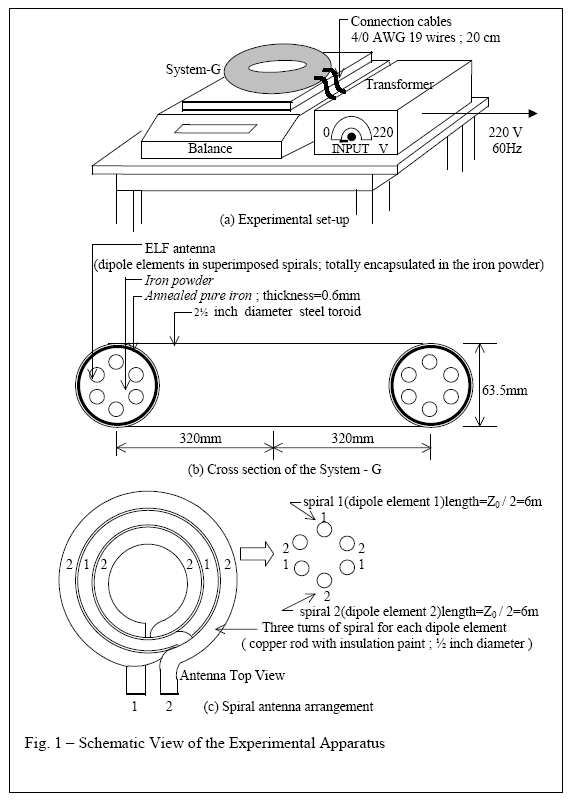
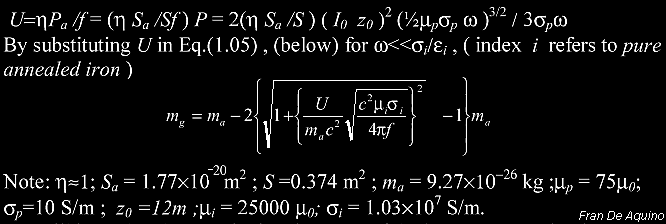
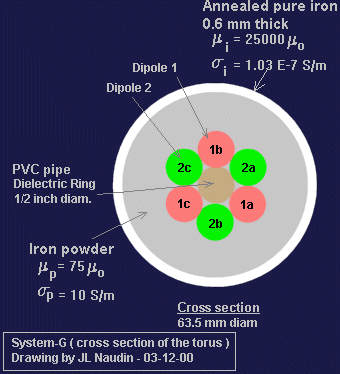
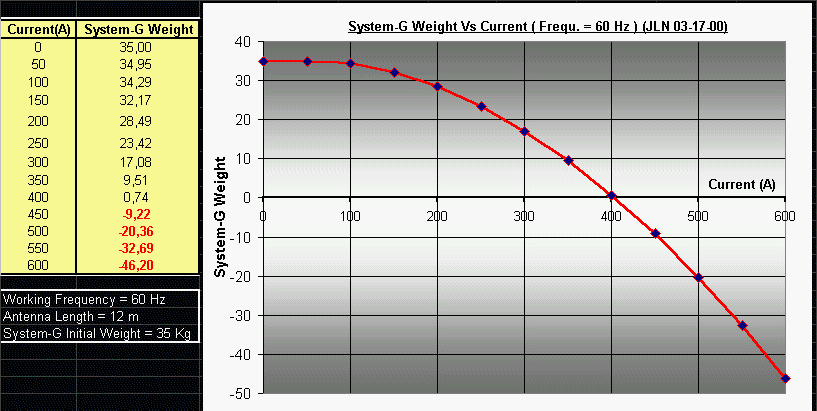
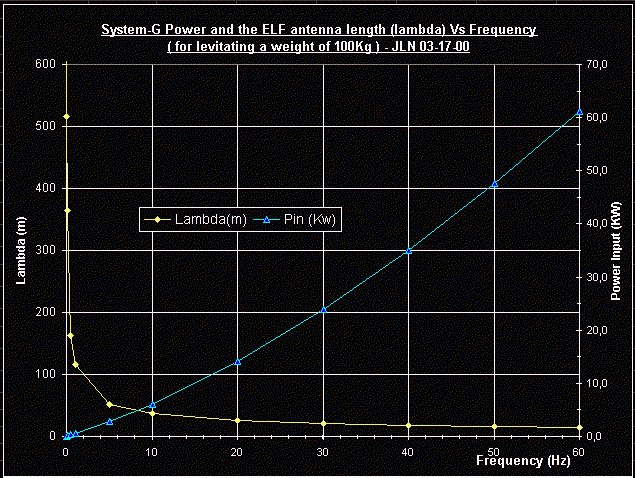
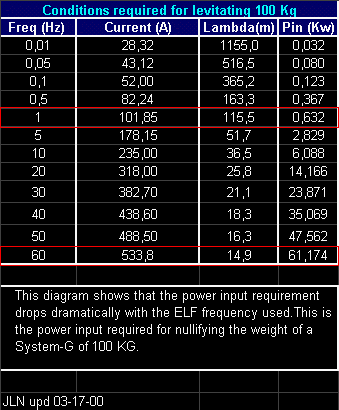
The author derives equations linking electromagnetic parameters to gravitational mass reduction. A critical radiation density D = hf^2/Sg defines a shield radius rs = (rg/f)(P/h)1/2. ELF frequencies far below 1 mHz are said to penetrate particles, forming photon clouds that cancel graviton exchange. Experiments (System-G) used a toroidal iron lamina energized at 60 Hz (power grid) with 400 A, achieving weight nullification of a 35 kg mass. Lower frequencies (1 Hz) reportedly require far less power (~=632 W) to levitate 100 kg. The author claims that with a spacecraft of mass m and a negative gravitational mass of (m-0.001) kg, a thrust of 10 N yields acceleration a = F/(mg) where mg ~= 0, allowing super-luminal speeds.
Principles
- Electromagnetic control of gravitational mass
- Mach's principle integration
- Photon-graviton shielding
- ELF field interaction with metallic lamina
Scientific Domains
Materials
- Annealed iron lamina
- Aluminum foil
- Copper coil (dipole antenna)
Mechanisms of Action
- ELF radiation absorbed by iron/aluminum creates photon cloud
- Photon cloud blocks graviton exchange, nullifying gravitational mass
- Reduced gravitational mass leads to negligible inertial resistance
Energy Sources
Applications
- Spacecraft propulsion
- Levitation devices
- Gravity control systems
Claimed Performance
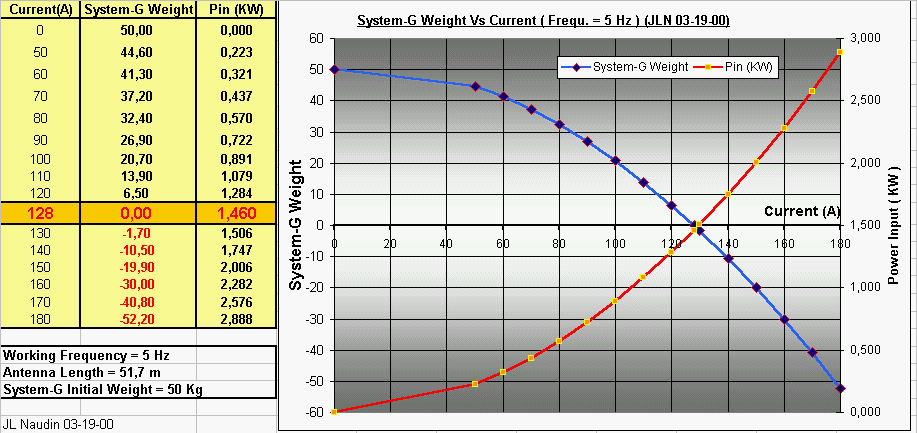
Weight nullification of 35 kg at 60 Hz with 400 A (~=11 kW). Levitation of 100 kg at 60 Hz requires 61 kW; at 1 Hz requires 632 W. Levitation of 50 kg at 5 Hz requires 1.46 kW. Thrust of 10 N produces acceleration sufficient to exceed light speed under the null-mass condition.
Experimental Evidence
The System-G experiment performed on 27 Jan 2000 at Maranhao State University reportedly achieved the above levitation results; curves and tables are shown in the PDF and article.
Replication Status
Only the author's own laboratory reports successful experiments; no independent replication is mentioned.
Limitations
- Requires very high electrical currents and power
- Relies on unverified physics (photon-graviton shielding)
- No peer-reviewed validation
- Potential conflict with relativity
Red Flags
- Extraordinary claims (null gravitational mass, super-luminal travel) without peer-reviewed evidence
- Reliance on unpublished equations and theoretical constructs
- No independent replication reported