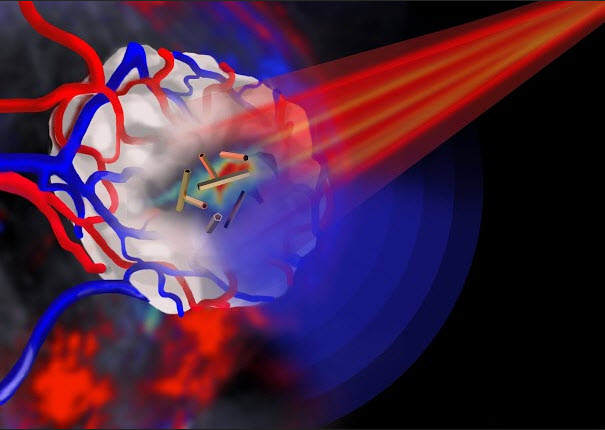
Goal
Integrate high-resolution imaging, drug delivery, and photothermal cancer cell ablation in a single nanomaterial platform.
Problem
Limited efficacy and serious side effects of conventional chemotherapy and radiotherapy; need for combined diagnostic and therapeutic (theranostic) approaches in cancer treatment.
Concept Summary
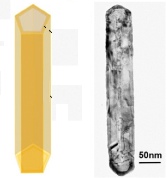
Gold nanotubes with controlled length and near-infrared (NIR) absorption are intravenously injected. They act as contrast agents for multispectral optoacoustic tomography by converting absorbed NIR light into ultrasound signals. When exposed to higher-intensity NIR laser pulses they generate localized heating for photothermal tumor ablation, and their hollow core can be loaded with therapeutic drugs for targeted delivery. The nanotubes are coated with poly(sodium 4-styrenesulfonate) (PSS) to improve colloidal stability and reduce cytotoxicity, and they are cleared hepatobiliary within 72 h.
Principles
- Surface plasmon resonance in gold nanostructures
- Photothermal conversion of near-infrared light
- Photoacoustic generation of ultrasound
- Nanoparticle-mediated drug delivery
Scientific Domains
Materials
- Gold
- Gold-silver alloy
- Poly(sodium 4-styrenesulfonate) (PSS)
- Silver nanowire (template for synthesis)
Mechanisms of Action
- NIR absorption -> rapid temperature rise -> cancer cell death
- NIR absorption -> thermoelastic expansion -> ultrasound emission for imaging
- Hollow core loading -> controlled release of therapeutic payload
Energy Sources
Applications
- Cancer imaging
- Cancer therapy (photothermal ablation)
- Targeted drug delivery
Claimed Performance
Successful in-vivo imaging and photothermal ablation of tumors in a mouse model; high NIR absorption; rapid clearance within 72 h; demonstrated drug loading capability.
Experimental Evidence
In vivo mouse studies showed photoacoustic imaging contrast and temperature-induced tumor cell death after NIR laser exposure; in vitro cellular uptake by colorectal cancer cells and macrophages; biodistribution and hepatobiliary clearance observed within 72 h.
Replication Status
No independent replication reported; study described as first in-vitro and in-vivo demonstration.
Limitations
- Requires external NIR laser equipment
- Current evidence limited to pre-clinical animal models
- Potential challenges in large-scale, reproducible synthesis