Goal
Provide uniform temperature throughout a space by destratifying air, reducing heating/cooling energy consumption.
Problem
Temperature stratification in rooms with high ceilings causing uneven heating and increased energy use.
Concept Summary
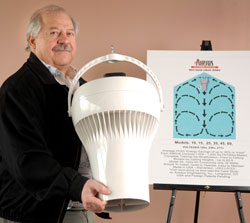
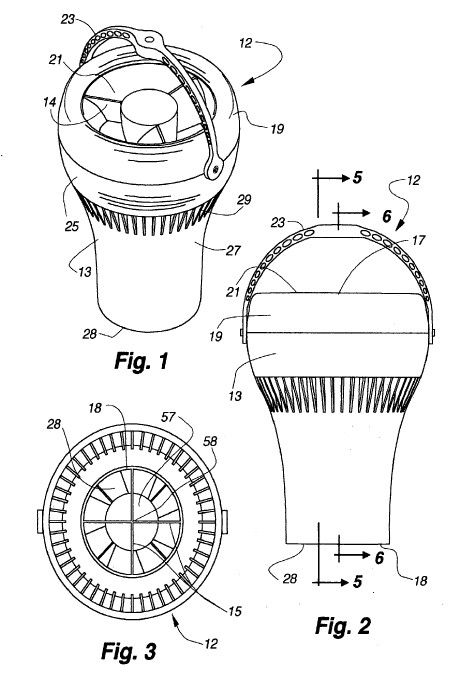
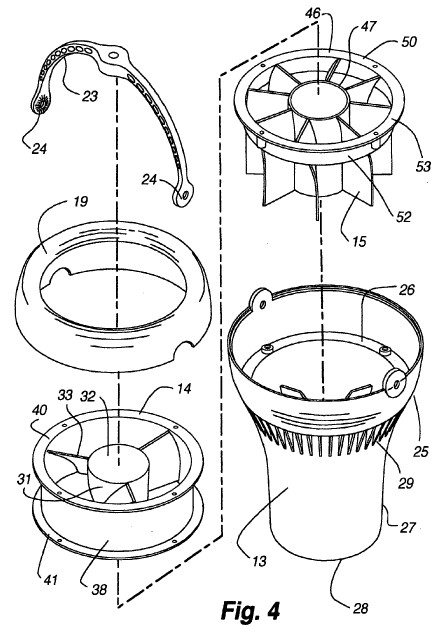
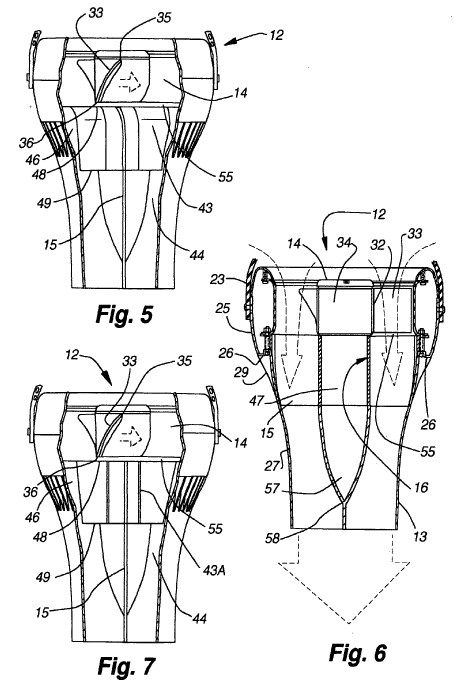
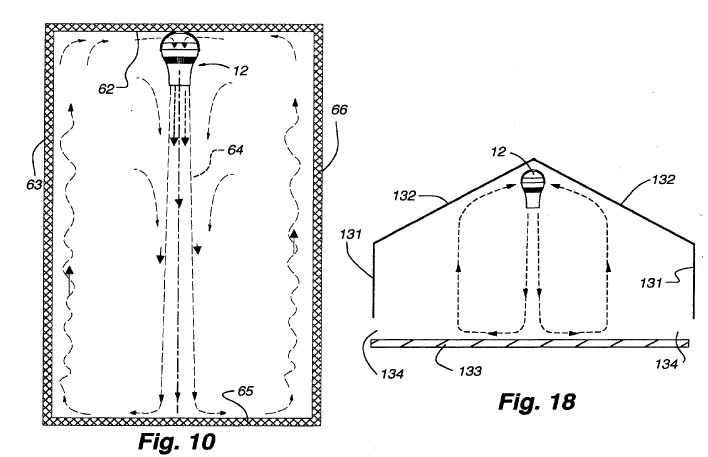
A ceiling-mounted cylindrical device that uses a rotary impeller and closely spaced guide vanes to produce a straight, columnar downward airflow, mixing warm ceiling air with floor air and storing heat in the floor, achieving energy-efficient temperature uniformity.
Detailed Description
The Thermal Equalizer is a cylindrical unit hung from a ceiling. Warm air that rises to the ceiling is drawn into an impeller; downstream radial vanes positioned very close to the impeller blades straighten the flow, minimizing rotary components and turbulence. The resulting laminar axial jet descends in a narrow column to the floor, where it spreads, pushes colder air upward, and creates a cyclical mixing that equalizes temperature. The device typically consumes power equivalent to a 35-watt light bulb, making it far more efficient than conventional ceiling fans. Variants include an ultraviolet light module for microbial kill. Units are sold in sizes ranging from small office models (~$400) to large hangar models (~$2,500).
Principles
- Columnar airflow
- Destratification
- Laminar axial flow
- Minimal rotary component
- Heat storage in floor
Scientific Domains
Materials
- Metal (housing and impeller)
- Plastic (grills, housings)
- UV lamp (optional variant)
Mechanisms of Action
- Rotary impeller generates downward airflow
- Radial guide vanes straighten airflow into a column
- Downward column mixes warm ceiling air with floor air
- Heat transferred to floor and stored in floor materials
- Optional UV light kills airborne microbes
Energy Sources
Applications
- Commercial building heating efficiency
- Aircraft hangar climate control
- Warehouse temperature uniformity
- Prison/jail air quality (UV variant)
- Large-area indoor spaces (gymnasiums, auditoriums)
Claimed Performance
Uses energy equivalent to a 35-watt light bulb; 11x more energy-efficient than prototype; users report ~20 % heating-bill savings.
Experimental Evidence
Customer testimonial (Todd Isaacson) reports 20 % heating-bill reduction; awards from U.S. Green Building Council and CORE; deployed in Boeing hangars and U.S. Air Force B-52 hangars.
Replication Status
Commercially deployed - ~12,000 units sold and used by multiple customers including Boeing and the U.S. Air Force.
Limitations
- Effectiveness depends on ceiling height and room geometry
- Requires electrical power
- Performance claims lack independent peer-reviewed data