Goal
Provide a high-tensile-strength, water-resistant structural cable for bridges, towing, and other load-bearing applications.
Problem
Need for strong, durable, and locally available rope/cable alternatives to steel or hemp that retain strength when wet.
Concept Summary
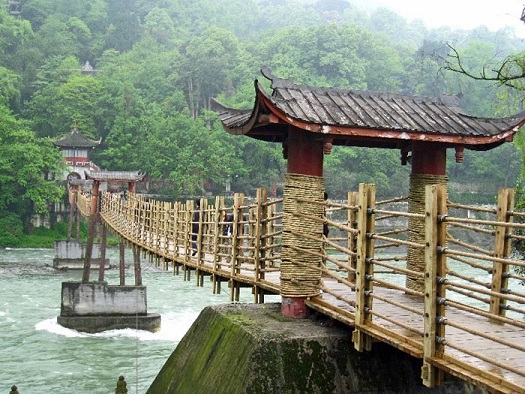
Twisted or plaited cables made from the silica-rich outer layer of bamboo culms (~=3 mm thick). The outer layer provides tensile strengths of 20 000-26 000 psi, improves when saturated with water, and resists wear against rock. Historical bridges used cables up to 76 m span and 2-inch diameter supporting 4 tons. Modern patents describe compressed, hardened bamboo-fibre bodies using thermosetting resins.
Detailed Description
Ancient Chinese engineers split bamboo canes lengthwise, removed the soft inner layer, and braided the silica-rich outer strips into cables. Engineers for the Whangpoo Conservancy Board measured a working stress of ~20 000 psi, comparable to steel wire of the same size. Hemp ropes lose ~25 % strength when wet, whereas bamboo cables gain ~20 % strength when fully saturated. The Anlan suspension bridge (c. 300 AD) used ten 21-inch-circumference cables to span a 1 000-ft river. Modern methods (WO2017204360) crush bamboo fibres, combine them with a thermosetting resin, and compress-mold to produce a homogeneous, hardened fibre body. Other patents (CN105734743, GB296333, CN106584629) detail fibre extraction, alkali treatment, and recombination processes to improve strength and manufacturability.
Principles
- Tensile strength of natural silica-rich fibers
- Water absorption increasing fibre cohesion
- Capillary adhesion of resin to fibre aggregates
Scientific Domains
Materials
- Bamboo outer layer (silica-rich)
- Thermosetting resin
- Alkali solutions (e.g., ammonium sulphate, caustic soda)
- Water
Mechanisms of Action
- Load bearing through tensile stress distribution in braided strips
- Wear resistance from silica-rich outer layer
- Resin infiltration and compression curing to densify fibre aggregates
Applications
- Suspension bridges
- Boat towing cables
- Construction rope
- Rural infrastructure
Claimed Performance
Working stress ~20 000 psi; tensile strength up to 26 000 psi; 2-inch diameter cable supports 4 tons; cables up to a quarter-mile long; bridge spans up to 76 m without central support.
Experimental Evidence
Engineers for the Whangpoo Conservancy Board estimated working stress; historical records (Marco Polo, ancient Chinese chronicles) describe bridge spans and load capacity; patents provide process data for compressed fibre bodies.
Replication Status
Historical use for >2000 years; modern patents indicate ongoing laboratory and limited commercial development.
Limitations
- Dependence on suitable bamboo species and quality of outer layer
- Labor-intensive splitting and braiding process
- Potential degradation over long term if not properly protected