Goal
Increase the distance and extinguishing effectiveness of fire-hose water streams
Problem
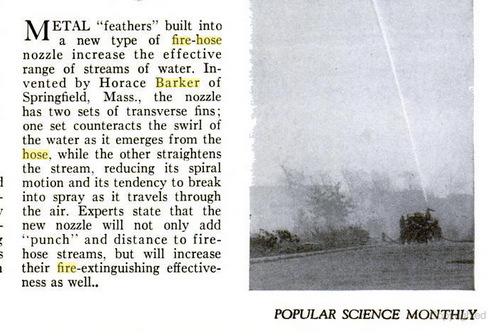
Swirling and turbulent flow in conventional fire-hose nozzles causes the water jet to break up, reducing range and firefighting performance
Concept Summary
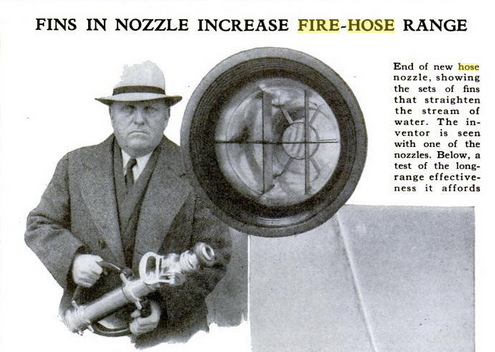
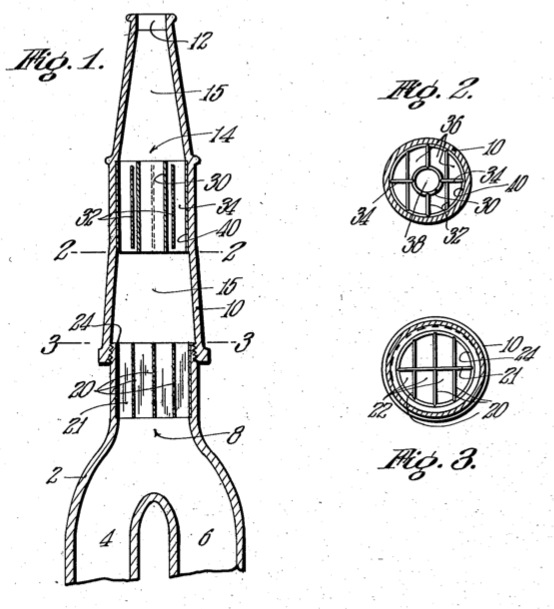
The invention adds a series of thin, transverse plates or "fins" inside the nozzle throat that are oriented parallel to the flow axis. These plates break up the swirling motion of the water, forcing it into a straight, laminar passageway. The resulting smooth jet travels farther and retains higher pressure, improving fire-extinguishing capability.
Detailed Description
A base with a converging throat houses multiple thin metal plates (or vanes) arranged transversely but parallel to the nozzle axis, creating a series of narrow passageways. Water entering the throat is forced through these passageways, which suppress turbulence and swirl. The nozzle may also contain a central tube surrounded by additional plates. The water exits a smaller-diameter outlet as a uniform, non-spraying stream that can be projected over greater distances.
Principles
- Fluid dynamics
- Turbulence suppression
- Laminar flow guidance
Scientific Domains
Materials
- Metal (e.g., steel or brass) for plates and nozzle body
Mechanisms of Action
- Transverse plates align with flow axis to straighten water path
- Reduction of swirl and turbulence by forcing water through narrow gaps
- Maintenance of pressure by minimizing jet breakup
Applications
- Fire fighting
- High-pressure water jet cleaning
Claimed Performance
Provides greater range and improved fire-extinguishing effectiveness compared with conventional nozzles
Experimental Evidence
Illustrations and a test described in a 1937 Popular Science article show the new nozzle delivering a longer-range water stream than standard nozzles
Limitations
- Requires a pressurized water supply
- Performance depends on precise fin geometry and installation