Goal
To preserve animal and vegetable matter indefinitely and to restore it to its original condition when needed.
Problem
Decomposition and deterioration of biological, organic, and cultural artifacts (e.g., tissue specimens, paper, cloth, paintings).
Concept Summary
The invention saturates the target material with an oil derived from Allium plants (garlic/onion). The oil's germicidal and restorative properties halt bacterial decay. After saturation the material can be dried for long-term storage and later re-hydrated in water to restore pliability. Fixatives such as alcohol or formaldehyde may be added to improve penetration in low-porosity tissues.
Detailed Description
The process begins by extracting oil or juice from garlic (Allium sativum) or related Allium species. The oil may be used in a volatile (vapour) or fixed (liquid) state, at any temperature between freezing and boiling. The material to be preserved is saturated by immersion, injection, dipping, or exposure to vapour until no further absorption occurs. Once saturated, the material can be dried and stored indefinitely. To restore the material, it is immersed in water, which washes out the germicidal agent, returning the specimen to its original pliability and volume. For tissues that collapse before the oil penetrates, a fixative (e.g., alcohol, formaldehyde) is mixed with the oil to speed cell entry. The method is applicable to animal bodies, anatomical specimens, paper, manuscripts, paintings, wood, silk, and other organic substrates.
Principles
- Germicidal action of Allium oil
- Saturation of porous material with preservative agent
- Reversible dehydration/rehydration cycle
- Use of fixatives to enhance penetration
Scientific Domains
Materials
- Garlic (Allium sativum) oil or juice
- Onion (Allium cepa) oil or juice
- Alcohol (ethanol)
- Formaldehyde
- Water
Mechanisms of Action
- Antibacterial compounds in garlic oil inhibit decay
- Oil penetrates pores and creates a barrier to moisture and oxygen
- Drying removes water, halting enzymatic activity
- Rehydration dissolves and removes the oil, restoring tissue elasticity
Applications
- Museum and archival conservation
- Medical and anatomical specimen storage
- Embalming of bodies
- Long-term storage of biological samples
Claimed Performance
Indefinite preservation of organic matter; complete restoration of original pliability and volume after water immersion.
Experimental Evidence
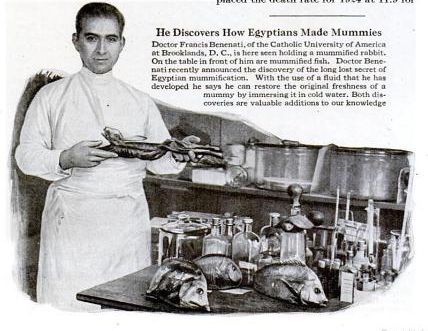
The inventor demonstrated the process on a mummified rabbit, mummified fish, and on paper/manuscript samples, claiming successful preservation and later restoration.
Replication Status
No independent replication or commercial scaling is reported in the text.
Limitations
- Requires material to be absorbent enough to reach saturation
- Strong odor of garlic oil may be undesirable
- Effectiveness on non-porous substrates (e.g., glass) not demonstrated
- Potential toxicity of high concentrations of oil or fixatives
Red Flags
- Claims are anecdotal and lack peer-reviewed data
- No independent replication or controlled experiments reported
- Potential for commercial exploitation without scientific validation