Goal
Produce liquid hydrocarbons, fuels and bitumen-like materials from inexpensive plant waste.
Problem
Dependence on finite fossil fuel reserves and high cost of conventional coal/oil production.
Concept Summary
Plant material containing both carbohydrates and lignin is heated (150-370 deg C) with alkaline reacting substances (e.g., lime, magnesia, carbonates, hydroxides, zeolites). The alkaline, high-temperature treatment converts the biomass into a bitumen-like "protoproduct" rich in hydrocarbons, phenols and other organics. Subsequent hydrogenation or cracking yields gasoline, kerosene, lubricating oil, coal, coke or asphalt.
Detailed Description
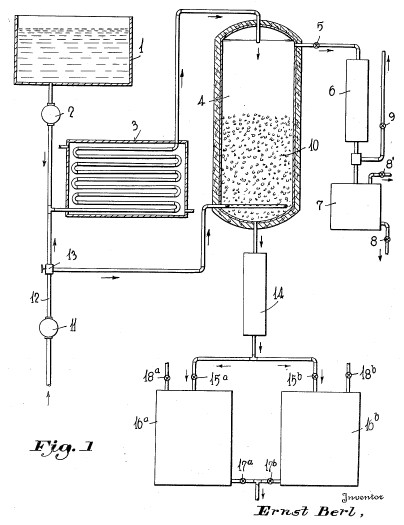
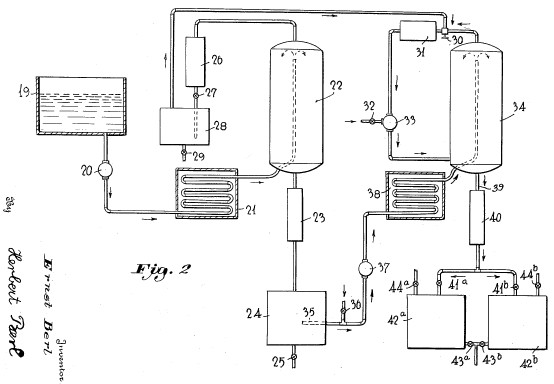
The process can be run continuously or batchwise. Raw biomass (sugarcane, wood, sorghum, potatoes, corn stalks, grass, seaweed, etc.) is mixed with water and an alkaline reagent (lime, magnesia, Na_2CO_3, K_2CO_3, CaCO_3, MgCO_3, NaOH, NH_4OH, Na_2S, K_2S, NH_4_2, zeolites, Fe(OH)_3, FeCO_3, FeS, etc.) and heated to 150-370 deg C. Under these conditions carbohydrates and lignin are depolymerised, producing a low-viscosity, brown-black bitumen-like material (14-19 % oxygen). Gases (CO_2, methane, other alipathic hydrocarbons) evolve. The aqueous phase contains phenols, phenol carbonic acids, formic acid esters, acetone and short-chain fatty acids, which can be recovered by standard separation techniques. The bitumen-like material can be hydrogenated or thermally cracked to give liquid hydrocarbons (gasoline, kerosene, lubricating oil) with high anti-knock values, or further processed into solid paraffins, coke or asphalt. Reported carbon yields from sugarcane are 64.5 % in the protoproduct, 59.9 % in the final gasoline/kerosene fraction.
Principles
- Alkaline hydrolysis / depolymerisation
- Thermal cracking
- Hydrogenation
Scientific Domains
Materials
- Sugarcane
- Wood
- Sorghum
- Potatoes
- Corn stalks
- Grass
- Seaweed
- Sawdust
- Bagasse
- Lime (CaO)
- Magnesia (MgO)
- Sodium carbonate (Na_2CO_3)
- Potassium carbonate (K_2CO_3)
- Calcium carbonate (CaCO_3)
- Magnesium carbonate (MgCO_3)
- Sodium hydroxide (NaOH)
- Ammonium hydroxide (NH_4OH)
- Sodium sulfide (Na_2S)
- Potassium sulfide (K_2S)
- Ammonium sulfide (NH_4)_2S)
- Zeolites
- Iron hydroxide (Fe(OH)_3)
- Iron carbonate (FeCO_3)
- Iron sulfide (FeS)
Mechanisms of Action
- Alkaline catalysed breakdown of carbohydrate and lignin polymers
- Thermal decomposition of organic matrix
- Catalytic hydrogen addition (hydrogenation) to unsaturated compounds
Energy Sources
Applications
- Fuel production from agricultural waste
- Synthetic gasoline, kerosene, lubricating oil
- Production of artificial bitumen/asphalt
Claimed Performance
Carbon recovery of 64.5 % in the protoproduct from sugarcane; 59.9 % carbon in the final gasoline/kerosene fraction; yields based on >50 experiments.
Experimental Evidence
More than 50 experiments over several years reported carbon yields from sugarcane (64.5 % in protoproduct, 59.9 % in gasoline/kerosene).
Replication Status
No independent replication reported.
Limitations
- Requires high temperature (150-370 deg C)
- Alkaline waste streams need handling
- Hydrogenation step adds complexity and cost
- Economic viability not demonstrated at commercial scale
Red Flags
- Claims based on author's own experiments only
- No peer-reviewed data or independent verification
- Potential over-statement of carbon yields