Goal
Provide underwater breathing without compressed-air tanks by extracting dissolved air from seawater.
Problem
Divers are limited by the amount of compressed air they can carry; tanks are bulky, require refills, and limit bottom time.
Concept Summary
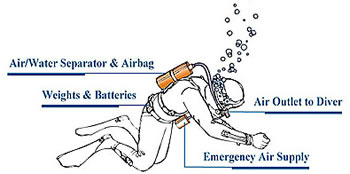
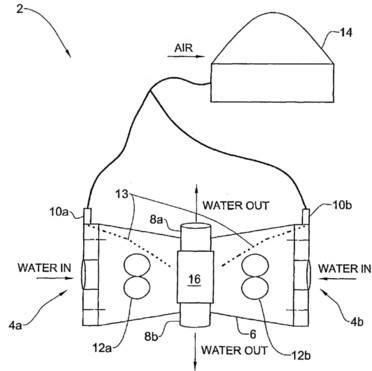
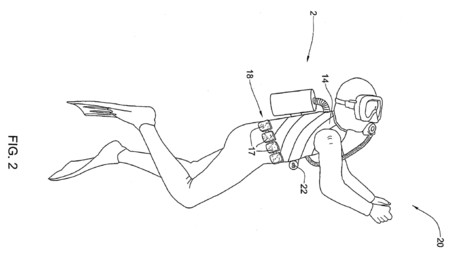
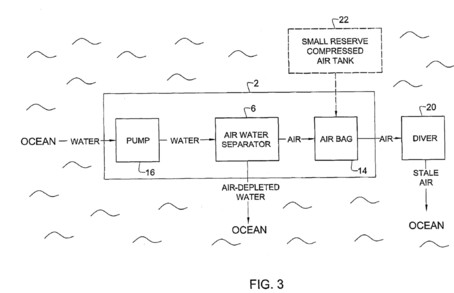
The system uses a rapidly rotating centrifuge to create a low-pressure zone inside a sealed chamber containing seawater. The pressure drop causes dissolved gases (oxygen and nitrogen) to come out of solution (Henry's law). The extracted gas is supplied to a closed-circuit rebreather, powered by a rechargeable lithium battery.
Principles
- Henry's Law (gas solubility vs. pressure)
- Centrifugal pressure reduction
- Closed-circuit breathing with CO_2 scrubber
Scientific Domains
Materials
- Lithium (battery)
- Metal alloy (centrifuge housing)
- Polymer seals
- Seawater (input fluid)
Mechanisms of Action
- Centrifugal pump creates low-pressure core
- Dissolved air nucleates and separates from water
- Battery powers centrifuge and water pump
- CO_2 removal and air recirculation for closed-circuit use
Energy Sources
Applications
- Scuba diving without tanks
- Submarine life-support
- Underwater habitats and research stations
Claimed Performance
A 1 kg lithium battery can sustain a diver for about one hour; closed-circuit water flow requirement ~=200 L min^-^1; extracted gas enriched to 34 % O_2.
Experimental Evidence
A laboratory model was built and tested in an aquarium, demonstrating that the centrifuge-based extraction principle works in practice.
Replication Status
Prototype (lab model) built and tested by the inventor; no independent replication reported.
Limitations
- High water-flow rates needed for open-circuit use
- Battery life limited to ~1 hour with current technology
- Size and weight of centrifuge may affect portability
- Energy consumption for continuous water processing
Red Flags
- Claims of indefinite underwater time without refills may be unrealistic.
- No independent third-party testing or peer-reviewed data presented.