Goal
Produce synthetic diamond crystals by electrolytic decomposition of molten calcium carbide.
Problem
Difficulty and low yield of existing artificial-diamond methods; need for a simpler, scalable process that can generate usable diamond sizes.
Concept Summary
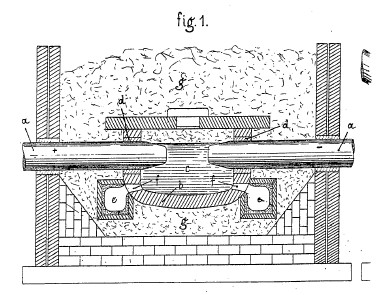
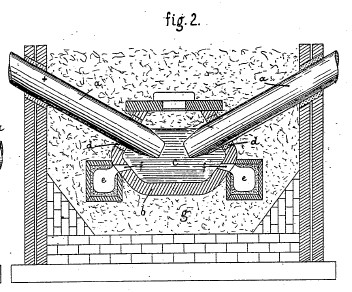
An electric furnace holds a molten bath of calcium carbide mixed with lime and carbon. Direct-current electrolysis decomposes the carbide; carbon precipitates at the cathode as diamond crystals. The furnace is built from refractory bricks, with carbon electrodes protected by magnesia tubes, and operated at 20-30 V and 500-800 A for several hours.
Detailed Description
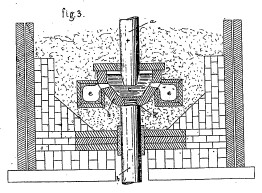
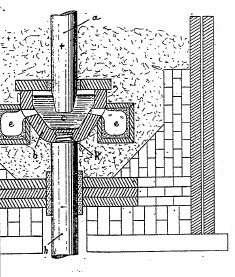
The furnace consists of a refractory brick enclosure containing a crucible (graphite or agglomerated coal) filled with a molten calcium-carbide bath. Lime-carbon mixture forms a protective hull around the crucible. Two carbon electrodes are inserted through refractory (.- during current (~=800 A at 34 V) the carbide decomposes; carbon collects on the negative electrode as a black mass containing diamond crystals. After cooling, the mass is washed, dried, and diamond particles (0.5-2.5 mm) are extracted with forceps. Reported runs produced up to 12 crystals per batch, with 11 successful runs out of 15.
Principles
- Electrolysis of molten metallic carbide
- High-temperature electric furnace operation
- Carbon precipitation at cathode
Scientific Domains
Materials
- Calcium carbide (CaC_2)
- Lime (CaO)
- Carbon (graphite electrodes)
- Refractory brick
- Magnesia (MgO) tubes
- Coal/graphite crucible
Mechanisms of Action
- Electrolytic decomposition of calcium carbide into calcium metal and carbon
- Carbon atoms nucleate and grow as diamond crystals on the cathode surface
Energy Sources
Applications
- Jewelry
- Industrial abrasives
- Cutting tools
Claimed Performance
Diamonds up to 2.5 mm in diameter produced; typical runs yield ~12 crystals per batch; 15 runs performed with 11 successful; power consumption about 12 kW.
Experimental Evidence
The article describes a specific run on 13 April 1908 (800 A, 34 V, 6 h) producing 600-700 g of residue from which ~12 diamonds (0.5-1.5 mm) were extracted and verified by microscopy and scratch tests. Subsequent runs (15 total, 11 successful) yielded crystals up to 0.1 in (~=2.5 mm).
Replication Status
Only reported by the inventor; no independent replication or peer-reviewed publication documented in the article.
Limitations
- Limited crystal size (max ~2.5 mm)
- Low yield per batch
- Requires large, high-current furnace
- No documented scale-up
Red Flags
- Lack of independent verification
- High electrical currents pose safety hazards
- Historical claim predates modern materials safety standards