Confidence
0.90
Practicability
0.10
Evidence
0.20
Fringe Score
0.80
Risk
0.10
TRL
1
Goal
Provide a physical mechanism for gravitation based on kinetic energy of the aether and radiation-pressure shadowing.
Problem
The absence of a satisfactory explanation for the source and transmission of gravitational energy in conventional physics.
Concept Summary
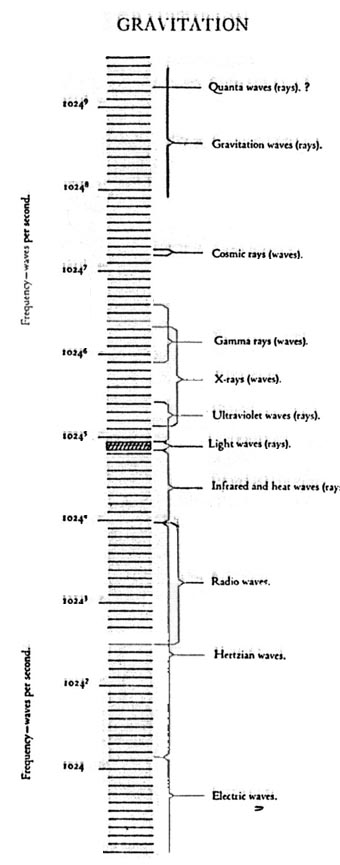
Brush proposes that the all-pervading aether possesses a huge, uniform kinetic energy in the form of low-frequency isotropic waves. Massive bodies partially shield each other from these waves, creating an imbalance of radiation pressure that pushes the bodies together, producing the observed inverse-square gravitational attraction.
Principles
- Kinetic energy of the aether as a uniform background
- Isotropic radiation pressure from aether waves
- Shadowing effect causing pressure differential between bodies
Scientific Domains
Mechanisms of Action
- Radiation pressure differential due to mutual shielding (shadowing)
- Momentum transfer from low-frequency aether waves to mass
Applications
- Fundamental physics research
- Alternative gravity models
Limitations
- No experimental verification
- Relies on the discredited aether concept
- Lacks quantitative predictions compatible with modern measurements
Red Flags
- Aether hypothesis contrary to contemporary physics
- Absence of empirical data or peer-reviewed validation
- Potential classification as pseudoscience