Goal
Provide thrust for aircraft/airship without conventional propellers or rockets by using a reciprocating weight mechanism.
Problem
Need for a new propulsion method that can generate lift and thrust efficiently, reducing reliance on traditional impact-based energy loss.
Concept Summary
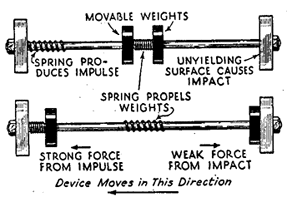
The reaction motor uses two weights moving in opposite directions inside a cylinder. One weight strikes a solid plate (impact) while the other compresses a spring (impulse). The impulse side conserves more energy, producing a net forward thrust. Weights are driven by electromagnets and can be reset mechanically for continuous operation.
Detailed Description
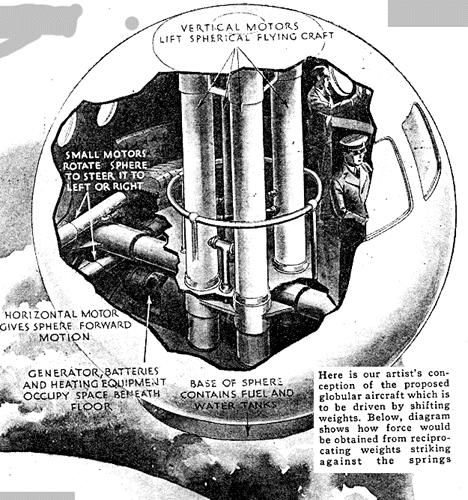
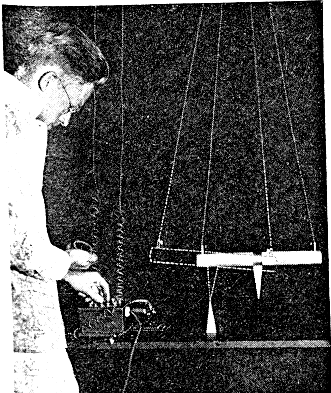
In the experimental model a cylindrical tube about a foot long contains two movable weights. When an electric switch is activated, electromagnets accelerate the weights in opposite directions. The heavier weight hits a flat steel plate and stops by impact, dissipating much energy as heat and deformation. The lighter weight strikes a spring, stopping by impulse and transferring most of its kinetic energy to the spring, which then pushes the cylinder forward. The cycle can be repeated continuously, providing a self-contained driving force. Bull envisions scaling the concept to multiple cylinders, using a carburetor-mix of vaporized gasoline and oxygen to drive the pistons, and arranging cylinders for lift and forward motion in an airship.
Principles
- Impulse-momentum transfer
- Conservation of momentum
- Mechanical energy conversion
- Spring-based energy storage
Scientific Domains
Materials
- Steel (plates, rod, cylinder)
- Spring steel
- Copper wire (electromagnets)
- Glass or metal cylinder housing
- Gasoline
- Oxygen
Mechanisms of Action
- Reciprocating weight motion
- Impact vs. impulse energy transfer
- Spring compression and release
- Electromagnetic actuation of weights
Energy Sources
Applications
- Aircraft propulsion
- Airship lift
- Steering of lightweight craft
Claimed Performance
A weight stopped by impulse can produce roughly three times the force of a weight stopped by impact; the device is claimed to be capable of lifting an aircraft when scaled.
Experimental Evidence
A laboratory model of the reaction motor was built; when the switch was turned on the cylinder leapt forward, demonstrating the principle of net thrust.
Replication Status
No independent replication reported; only the inventor's laboratory demonstration is described.
Limitations
- Low overall efficiency due to impact losses
- Mechanical wear and heat from repeated impacts
- Complexity of synchronizing opposite-direction weights
- Safety concerns with explosive fuel mixture
Red Flags
- Claims of "defying gravity" without quantitative data
- Lack of peer-reviewed performance measurements
- Potential safety hazards from explosive fuel and high-velocity impacts