Goal
Increase fuel economy (reduce gasoline consumption) while maintaining power and keeping emissions low.
Problem
High fuel consumption and NOx emissions in gasoline engines, especially when using lean-burn or EGR strategies that upset catalytic converters.
Concept Summary
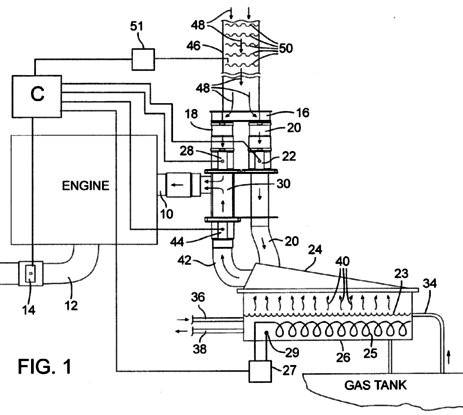
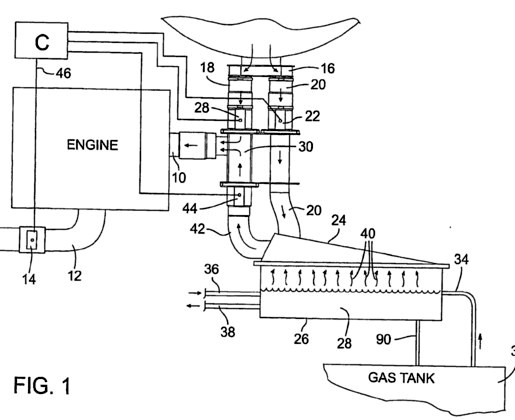
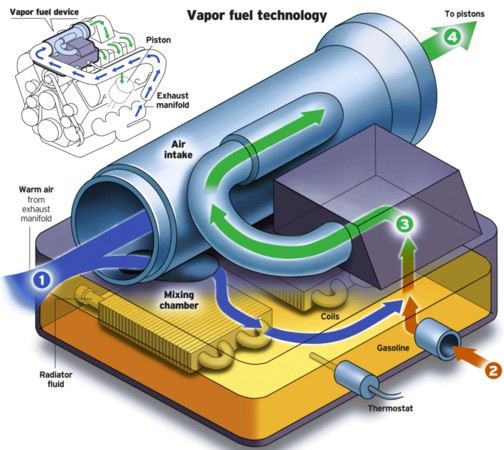
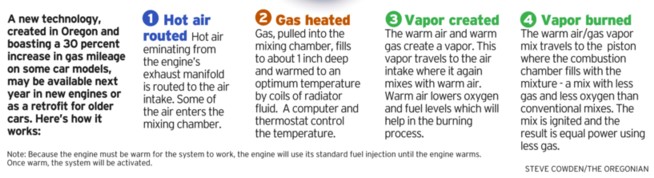
The system vaporizes gasoline and pre-heats the intake air using waste heat from the radiator and exhaust manifold. The heated, expanded mixture retains the correct air-fuel ratio, allowing higher flame speed and auto-ignition, which improves combustion efficiency and reduces fuel use by roughly 30 % without increasing NOx.
Detailed Description
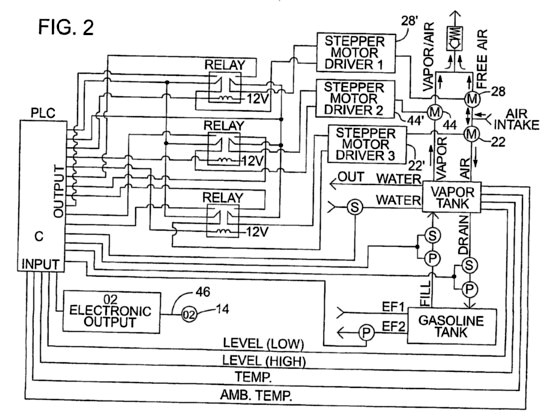
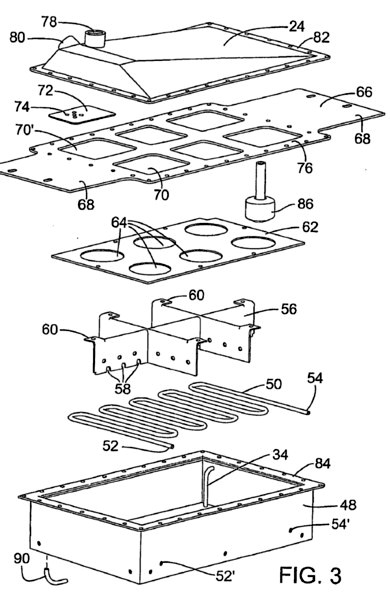
A vaporizing tank heats gasoline to a gaseous state. Simultaneously, a heat-exchanger draws waste heat from the radiator to raise the temperature of incoming air. The hot air expands, increasing its volume, which compensates for the reduced fuel mass, keeping the overall air-fuel ratio stoichiometric. The mixture enters the cylinder where the higher temperature and pressure promote faster flame propagation and controlled auto-ignition (a form of HCCI). Moderate exhaust gas recirculation (EGR) is also used to fine-tune dilution. The system is controlled by an onboard computer that synchronizes timing with the engine's existing control unit.
Principles
- Vaporization of fuel
- Heat exchange (waste-heat recovery)
- Thermal expansion of gases
- Homogeneous charge compression ignition (HCCI)
- Air-fuel ratio control
- Flame speed enhancement
Scientific Domains
Materials
- Gasoline
- Air
Mechanisms of Action
- Fuel vaporization
- Pre-heating of intake air
- Thermal expansion to maintain stoichiometry
- Increased flame speed
- Auto-ignition timing
- Moderate EGR for dilution
Energy Sources
Applications
- Light trucks
- Sport utility vehicles
- Gasoline-powered passenger cars
Claimed Performance
~=30 % increase in vehicle mileage (fuel economy) in a Ford F-150 test.
Experimental Evidence
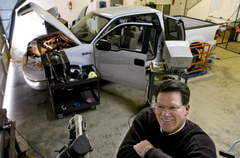
A CARB-certified laboratory in Southern California measured a 30.1 % mileage improvement on a Ford F-150 equipped with the Vapor Fuel system.
Replication Status
Single independent laboratory test; no further public replication reported.
Limitations
- Requires integration with vehicle's onboard computer
- Performance in cold weather or high altitude not proven
- Regulatory certification (CARB) still pending
Red Flags
- Only one publicly documented test; no independent replication
- Claims rely on proprietary control algorithms not disclosed