Goal
Produce net-positive fusion power using a compact, grid-less electrostatic confinement reactor.
Problem
Current fusion approaches (tokamaks) are large, costly, and have not achieved net power; a smaller, cheaper fusion source is needed for clean energy and spacecraft propulsion.
Concept Summary
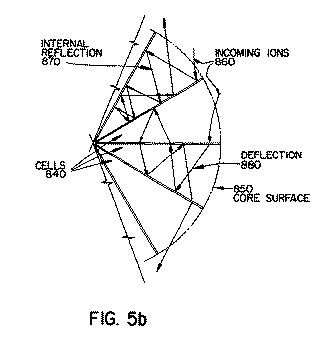
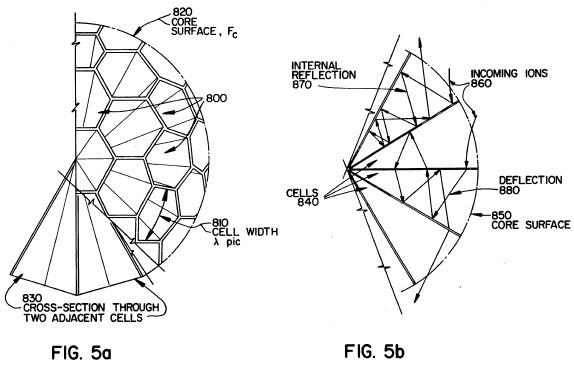
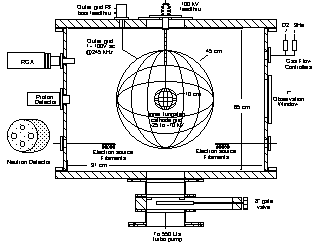
Bussard's IEC device uses a high-voltage (~=10 kV) pulsed discharge in a vacuum chamber surrounded by magnetic coils that shield the plasma from metallic surfaces. By limiting the fraction of metal surface exposed to the magnetic field to <10^-^4 of the total area and ensuring electrons recirculate ~10^5 times before loss, electron losses are decoupled from ion confinement, allowing a grid-less potential well that traps ions and yields deuterium-deuterium fusion at rates claimed to be 100 000x higher than earlier fusors.
Principles
- Electrostatic confinement of ions
- Magnetic insulation of coil surfaces
- Grid-less fusor design
- Electron recirculation and loss suppression
Scientific Domains
Materials
- Copper coil conductors
- Steel vacuum chamber
- Insulating ceramic spacers
- Vacuum-compatible structural supports
Mechanisms of Action
- High-voltage electron injection creates a negative potential well
- Magnetic coils prevent B-field penetration of metal surfaces
- Ions are trapped and accelerated toward the center, undergoing DD fusion
- Electron losses are minimized by limiting metal exposure and enabling many recirculation cycles
Energy Sources
Applications
- Clean electricity generation
- Spacecraft propulsion (boron-11 aneutronic fusion)
- Scientific research on IEC fusion
Claimed Performance
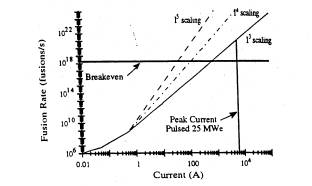
Fusion rate ~=1 x 10^9 reactions / s, about 100 000x higher than previous IEC devices; pulse duration ~=0.4 ms with electron lifetime ~=0.1 us.
Experimental Evidence
Tests on 9-10 Nov 2005 produced DD fusion at ~10 kV, 1300 G in a 30 cm device (WB-6) with a fusion rate of ~1 x 10^9 / s; a subsequent test on 11 Nov caused a coil short and device failure.
Replication Status
No independent replication reported; only the author's own laboratory results are described.
Limitations
- Short pulse operation; no steady-state demonstration
- Device failure due to coil movement and insulation breakdown
- Scale-up challenges (requires 150-200 M for full-scale demo)
- Funding and political obstacles
Red Flags
- Extraordinary performance claims without peer-reviewed data
- Reliance on unpublished internal reports and forum posts
- Potential bias due to funding pressures and political statements