Goal
Improve tire handling, braking, safety, fuel efficiency, reduce tread wear and rolling resistance.
Problem
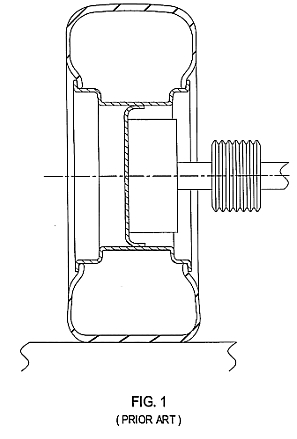
Conventional radial tires suffer from limited camber angles, higher rolling resistance, uneven tread wear, reduced fuel economy, and rollover risk.
Concept Summary
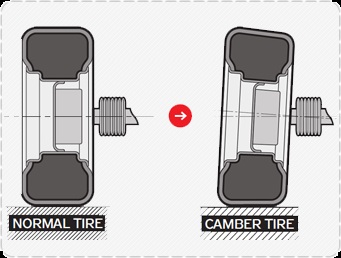
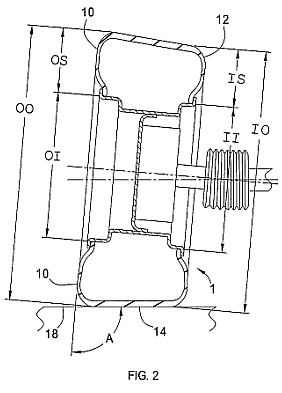
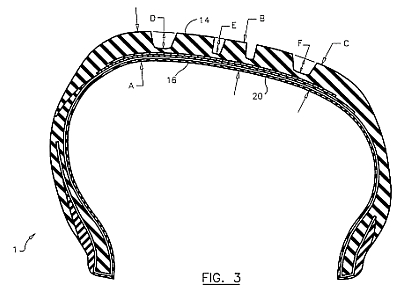
The Camber Tire incorporates an asymmetrical sidewall profile with a taller outer sidewall and a shorter inner sidewall, a decreasing diameter across the tread, and rocker-type tread extensions. The geometry creates built-in camber thrust, improves contact patch during roll, reduces rolling resistance and allows narrower, lighter tires while maintaining handling and safety.
Detailed Description
The patented design (US 5,975,176) features a trapezoidal cross-section where the outer sidewall height exceeds the inner sidewall height, producing a constantly decreasing diameter from the outer to the inner sidewall. A "rocker" tread pattern on the inner and outer corners adds extra contact when the tire rolls side-to-side. The design can be applied to any tire size by altering moulds and alignment settings, eliminating the need for toe-in alignment. Test vehicles equipped with the Camber Tire showed reduced stopping distances, increased cornering grip, quieter operation, and longer tread life.
Principles
- Asymmetrical sidewall geometry
- Built-in camber angle (camber thrust)
- Rocker tread extensions for roll stability
- Reduced rolling resistance
- Optimized contact patch
Scientific Domains
Materials
- Rubber
- Steel
Mechanisms of Action
- Geometric camber creates lateral force without additional steering input
- Rocker tread maintains contact on the rolling edge, increasing lateral grip
- Decreasing diameter reduces sidewall flex and rolling resistance
- Narrower profile lowers aerodynamic drag
Applications
- Passenger passenger
- Racing (track day, SCCA Solo)
- SUVs and minivans (rollover prevention)
- Truck and trailer tires
Claimed Performance
Shortened stopping distance by 11 ft, increased cornering grip by >4 %, quieter running, reduced tread wear, up to 6 % fuel-economy gain.
Experimental Evidence
Independent tests conducted by Automobile Magazine at Bosch proving grounds, public roads in Michigan and Tire Rack facilities in Indiana using two Mitsubishi Lancer Evolution cars. The R-compound Camber Tire showed an 11-ft reduction in braking distance and >4 % increase in lateral acceleration compared with standard Yokohama Advans tires. One Tire Rack customer rated the Camber Tire "simply the best tire an Evo driver can get" after 23,000 mi of use.
Replication Status
Independent testing performed by Automobile Magazine and Tire Rack; results reported in June 2010 issue of Automobile Magazine.
Limitations
- Requires new moulds and alignment adjustments
- High camber angles may increase uneven tread wear if not matched with suspension
- Limited data on long-term durability and large-scale manufacturing cost
Red Flags
- Performance claims are based on limited independent testing; broader industry validation is pending.