Goal
Provide a high-efficiency, low-vibration internal combustion engine that operates without a crankshaft or timing gears and matches optimal propeller speed.
Problem
Conventional aircraft engines require a crankshaft and timing gears, run at high RPM for power (which is inefficient for propellers), and suffer from vibration due to unbalanced reciprocating masses.
Concept Summary
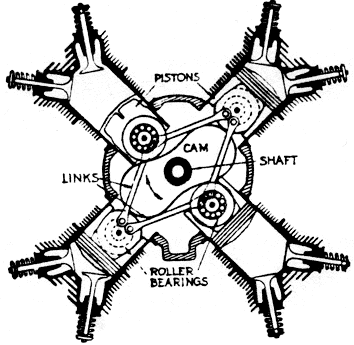
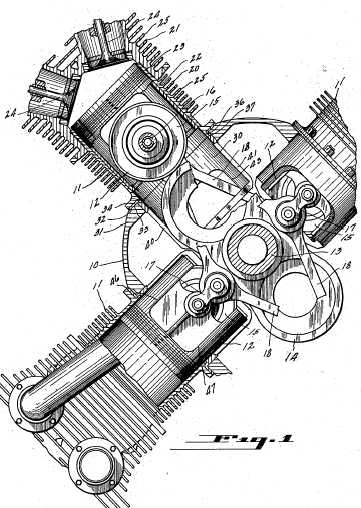
The Caminez engine replaces the crankshaft with a straight shaft carrying a figure-8 shaped steel cam. The cam engages roller bearings mounted in each piston. Four lightweight links connect the pistons so that the cam pushes two pistons up while pulling the other two down, producing two complete strokes per shaft revolution. This halves the shaft speed while keeping piston speed high, eliminates gears and a camshaft, and inherently balances the four-cylinder layout to remove vibration.
Detailed Description
A straight central shaft carries a large steel cam shaped like a figure-8. The cam contacts roller bearings in each of the four pistons. Two pistons are pushed upward by the cam while the other two are pulled downward by lightweight connecting links. The links are lighter than conventional connecting rods because they only need to move pistons on the intake stroke. Because the cam makes two full piston cycles per shaft turn, the shaft rotates at half the speed of a conventional crankshaft engine, allowing the propeller to operate at its optimal lower speed while the pistons still achieve high-speed power strokes. The arrangement also provides inherent mechanical balance, eliminating vibration.
Principles
- Figure-8 cam driven piston motion
- Roller bearing engagement
- Reciprocating mass balancing
- Double-stroke per shaft revolution
Scientific Domains
Materials
- steel
- iron
- aluminum
Mechanisms of Action
- Combustion pressure pushes pistons against cam profile
- Cam profile translates linear piston motion into rotational shaft motion
- Lightweight links pull opposite pistons to complete the cycle
- Inherent balance reduces vibration
Energy Sources
Applications
- aircraft propulsion
- light aircraft engines
- automotive engines
Claimed Performance
Engine runs at half the shaft speed of conventional engines while maintaining high piston speed, eliminates crankshaft and gears, and is inherently vibration-free.
Experimental Evidence
Successful airplane test flight at Farmingdale, Long Island, using the Caminez engine.
Replication Status
Prototype demonstrated in a single aircraft test flight; no further scaling reported.
Limitations
- Manufacturing precision required for figure-8 cam and roller bearings
- Potential wear of roller bearings under high loads
- Limited data on long-term durability and efficiency