Goal
Raise intracellular pH of cancer cells to inhibit their division and cause tumor shrinkage while relieving pain.
Problem
Cancer (tumor growth and associated pain).
Concept Summary
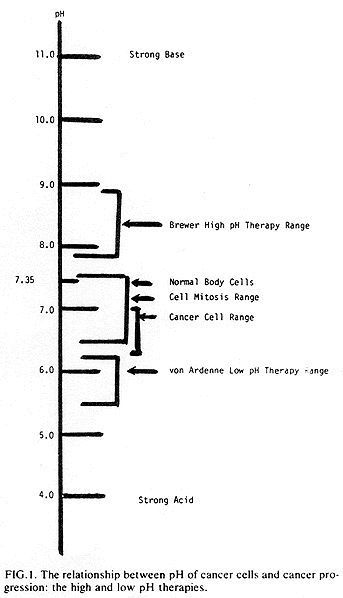
The therapy administers cesium chloride (CsCl) or rubidium chloride (RbCl) together with vitamins and trace metals to exploit the preferential uptake of Cs+ and Rb+ ions by cancer cells. The ions raise the cell's pH to around 8, a range where cancer cells cannot survive, leading to rapid tumor regression and pain relief.
Detailed Description
Based on isotope effect studies showing that cancer cells preferentially absorb K+, Rb+, and Cs+ ions, the author proposes a high-pH therapy. Patients receive up to ~6 g of CsCl (or 1.11 g of Rb carbonate) per day, along with vitamins C and A, zinc, and selenium salts, which enhance ion uptake. The elevated intracellular pH disrupts membrane electron-donor gradients, neutralizes acidic toxins released by tumors, and shortens cancer cell lifespan. Mouse experiments showed tumor weights reduced to one-eleventh of controls; human case reports (>30 patients) claimed complete tumor disappearance and pain relief within 12-36 hours. The therapy is contrasted with a low-pH approach that uses heat and diathermy.
Principles
- Ion transport across membranes
- Isotope effect on cellular uptake
- Membrane potential and electron-donor gradients
- Intracellular pH manipulation
- Selective toxicity of high pH to cancer cells
Scientific Domains
Materials
- Cesium chloride (CsCl)
- Rubidium chloride (RbCl)
- Rubidium carbonate (Rb2CO3)
- Cesium carbonate (Cs2CO3)
- Vitamin C (ascorbic acid)
- Vitamin A (retinoic acid)
- Zinc salts
- Selenium salts
Mechanisms of Action
- Preferential uptake of Cs+ / Rb+ ions by cancer cells raises intracellular pH
- Elevated pH disrupts metabolic processes and induces cell death
- Neutralization of acidic tumor toxins by administered salts
Applications
- Cancer treatment
- Pain management in oncology
Claimed Performance
In mice, tumor weight reduced to one-eleventh of controls; 97 % curative effect reported for intraperitoneal Cs carbonate. In >30 human cases, tumors disappeared and pain vanished within 12-36 hours.
Experimental Evidence
Mouse studies with implanted mammary tumors showed 1/11 tumor weight in treated groups versus controls. Human case series reported by H. Nieper, H. Sartori, and others described complete tumor regression and pain relief after oral CsCl dosing.
Replication Status
Limited replication reported by multiple investigators (Nieper, Sartori, Messiha) but no independent, peer-reviewed clinical trials.
Limitations
- Lack of controlled, peer-reviewed clinical trials
- Potential toxicity at high cesium doses
- Side effects such as nausea and diarrhea
Red Flags
- Extraordinary cure claims without rigorous scientific validation
- Possible false hope for patients
- Unclear regulatory status of high-dose cesium therapy