Goal
To alter the rate of the flow of time (slow down or speed up) within a localized volume using electromagnetic fields.
Problem
Inability to control or manipulate the passage of time for experimental, scientific or practical purposes.
Concept Summary
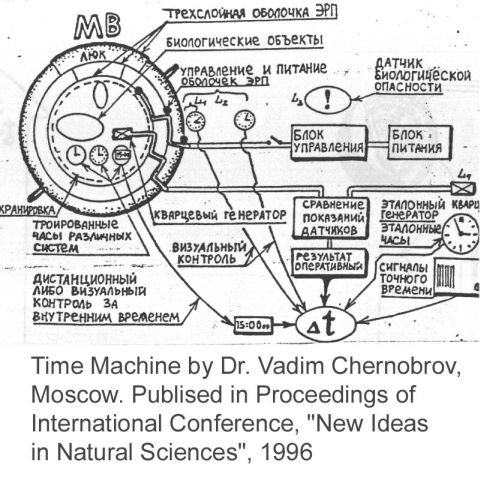
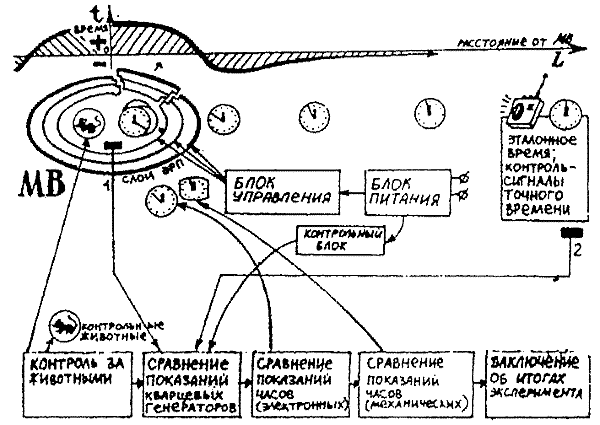
A layered spherical arrangement of electromagnets (Electromagnetic Working Surfaces) is powered in impulse mode to generate converging electromagnetic waves that are claimed to change the local density of space-time, thereby slowing down or accelerating the passage of time as measured by various clocks.
Detailed Description
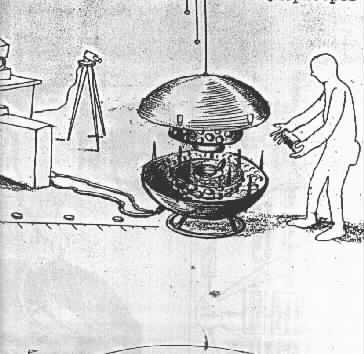
The experimental setup consists of 3-5 concentric globe-shaped electromagnetic surfaces (EWS) with diameters ranging from 115 mm to about 1 m. Electromagnets are wired in series and parallel and driven by short-duration high-current pulses from a power source (car batteries, transformer). Inside the innermost sphere, test subjects (mice, insects) and time-keeping devices (quartz, electronic, mechanical, nuclear clocks, fiber-optic diodes) are placed. Reported measurements indicate changes in the local time rate of up to -1.5 s/h (slowdown) and +0.5 s/h (speed-up), with one anomalous run showing -4 min per 8 h. The system is described as a "space-time energy pump" that modifies the density of the ether or space-time continuum.
Principles
- Electromagnetic fields affect the space-time continuum
- Impulse-mode powering of electromagnets creates converging spherical waves
- Local modification of ether density (space-time density) alters time flow
Scientific Domains
Materials
- Copper wire (electromagnet coils)
- Iron/steel cores
- Paper-mache (electromagnetic skins)
- Quartz crystal oscillators
Mechanisms of Action
- Generation of high-intensity pulsed magnetic fields
- Converging spherical electromagnetic wave propagation toward a central point
- Energy pumping into local space-time to change its density
Energy Sources
Applications
- Fundamental research on time-space physics
- Potential temporal navigation or time-dilation technologies
Claimed Performance
Slowing down up to -1.5 seconds per hour, acceleration up to +0.5 seconds per hour; one experiment reported -4 minutes per 8 hours (~= -30 seconds per hour).
Experimental Evidence
Measurements performed with quartz, electronic, mechanical, nuclear clocks and duplicated quartz generators; reported changes in time rate of a few seconds per hour, with occasional larger anomalies.
Replication Status
No independent replication reported; only the original research team's observations are mentioned.
Limitations
- Lack of peer-reviewed publications
- No independent verification or replication
- Unclear energy efficiency and scalability
- Potential safety hazards to subjects inside high-field environment
Red Flags
- Extraordinary claims without peer-reviewed evidence
- Reported catastrophic explosion of experimental module
- Use of vague terms like "ether" and "energy pumping"
- Absence of quantitative error analysis