Goal
Remote, scalable self-assembly of nanomaterials (e.g., carbon nanotubes) into macroscopic wires and circuits.
Problem
Difficulty in assembling nanoscale building blocks into larger, functional structures in a controllable and scalable manner.
Concept Summary
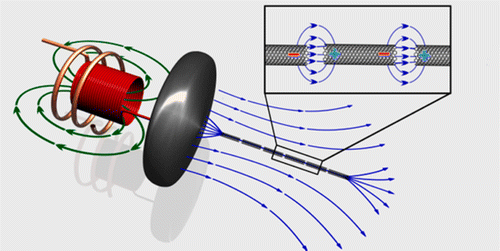
A high-voltage Tesla coil creates a strong, spatially extended electric-field gradient that polarizes conductive nanomaterials such as single-walled carbon nanotubes. The induced dipoles experience dielectrophoretic forces that align and pull the nanotubes together, forming continuous nanowires over distances of tens of centimeters. The same field can also wirelessly power simple circuits (e.g., LED loads) built from the assembled nanotubes.
Detailed Description
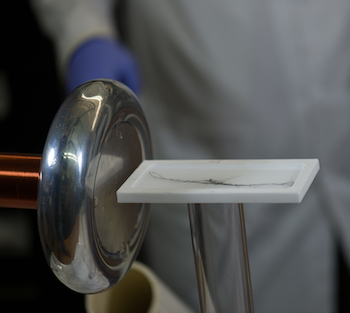
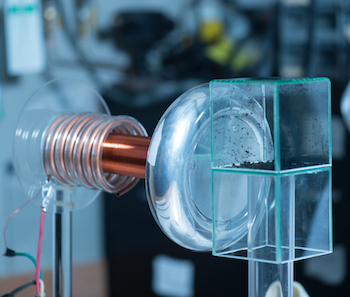
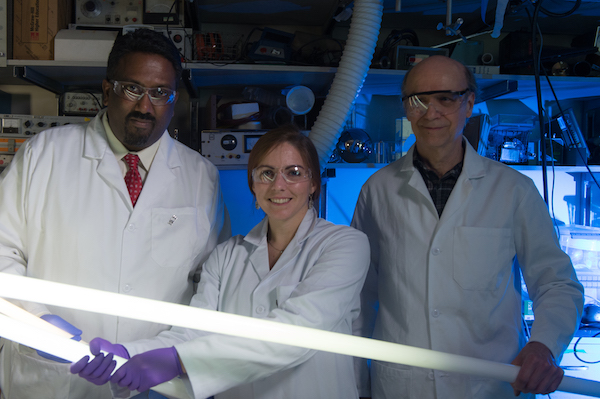
The researchers built a bench-top Tesla coil that generates a high-voltage, high-frequency alternating electric field extending into free space. When carbon nanotubes are placed within this field, each tube becomes polarized, producing induced dipoles that experience a net force toward regions of higher field intensity. This force aligns the tubes and draws them together, causing them to chain-assemble into long, continuous wires up to 15 cm in length. The assembled wires can bridge electrical contacts, forming circuits that harvest energy from the same field to light LEDs. The effect has been observed at distances greater than 30 cm from the coil, and the authors suggest that larger or patterned coil arrays could enable more complex self-assembled structures.
Principles
- Electrokinetic (dielectrophoretic) force
- Polarization of conductive nanomaterials
- High-voltage electric-field gradient
Scientific Domains
Materials
- Single-walled carbon nanotubes
- Other conductive nanomaterials (potentially)
Mechanisms of Action
- Induced dipole formation in nanotubes
- Dielectrophoretic attraction toward field maxima
- Self-assembly via chain formation
Energy Sources
Applications
- Scalable nanowire fabrication
- Flexible electronics
- Regenerative medicine scaffolds
- Sensor arrays
Claimed Performance
Nanowire lengths up to 15 cm; self-assembly observed at distances >30 cm; LEDs lit wirelessly using harvested field energy.
Experimental Evidence
Demonstrated in ACS Nano (2016) with photographs and video of nanotube wires forming and lighting LEDs; quantitative lengths and distances reported.
Replication Status
No explicit replication reported in the article.
Limitations
- Effective range limited to a few feet with current coil size
- Requires high-voltage equipment
- Primarily demonstrated with carbon nanotubes; other materials untested